Mara Mennella – EU Project Manager

  • Canta che ti passa! Lùnapop – Un giorno migliore

    Canta che ti passa! Lùnapop – Un giorno migliore

    Con Un giorno migliore dei Lùnapop lavoriamo sull’indicativo futuro per le classi di livello tra A1 e A2 e, perché no, sul nostro umore in questi giorni complicati.

    Una canzone per ripassare il futuro

    L’ispirazione viene grazie a Coca Cola, che ha usato #ungiornomigliore per sponsorizzare la raccolta fondi per la Croce Rossa Italiana.

    https://www.youtube.com/watch?v=1No-Ll-PdVY

    Da lì ho creato una scheda riassuntiva di chi sono i Lùnapop con alcuni esercizi per imparare del lessico nuovo e riflettere sulle emozioni, oltre che sul futuro. Potete fare copia-incolla della sezione successiva.

    Lùnapop – Un giorno migliore

    I Lùnapop sono stati un gruppo musicale italiano formatosi a Bologna tra il 1999 e il 2002. I componenti sono: Cesare Cremonini, Nicola Balestri, Gabriele Galassi, Alessandro De Simone e Michele Giuliani. Nel corso della sua breve storia, la band pubblica un solo disco, …Squérez?, da cui vengono estratti sei singoli (50 Special, Un giorno migliore, Qualcosa di grande, Resta con me, Vorrei e Se ci sarai) che ottengono un grande successo radiofonico in Italia, fanno concerti e un tour anche in Spagna. Cesare è il cantante dei Lunapop ed il fondatore. Le canzoni di questi cinque ragazzi parlano del mondo giovanile, d’amore, di sentimenti e subito piacciono molto ed entrano in classifica. Nel 2002 il gruppo si scioglie e Cesare Cremonini intraprende una carriera da solista.

    Nel 2020 Un giorno migliore, una delle canzoni più famose di Cesare Cremonini, si trasforma in un inno di speranza. Coca Cola usa la canzone e #ungiornomigliore per sostenere le attività della Croce Rossa Italiana[1]. Con la collaborazione del cantante bolognese, la famosa azienda ha attivato una campagna di crowdfunding[2].

    1. Ascolta la canzone

    2. Secondo te come è questa canzone?

    Rock/bella/dolce/allegra/noiosa/romantica/sdolcinata/triste/malinconica/piacevole

    Puoi aggiungere altri aggettivi.

    ___________________________________________________

    3. Ascolta di nuovo la canzone e completa il testo

    Cosa mi aspetto dal domani?
    Il sole in faccia no,
    ma in fondo io ci ______ancora
    Che tu ci sia nel mio domani
    E se ti __________,
    spero di ____________ le tue mani

    Soli eppure in mezzo alla gente io e te,
    riscaldati dal calore di una “Benson and Hedges”
    Se mi vuoi, domani ________ un giorno migliore vedrai
    Se mi vuoi, domani _________ un giorno migliore vedrai!

    E cosa dire di noi
    forse che in fondo ________________ se tu mi vuoi.
    Cosa mi aspetto dal domani
    Beh credo che sia giusto dirti che non ___ niente senza te
    E tu sei molto di più di quello che tu sai
    Sei sole e pioggia negli inverni miei

    Se mi vuoi, domani _________ un giorno migliore vedrai

    Aspetta almeno un minuto,
    non dirmi che non mi vuoi
    ___________ _ trovare un appiglio,
    prima che tu te ne ____ da me.
    Apri le tue ali e vola via con me

    Cosa mi aspetto dal domani? …
     

    4. Scegli la risposta corretta

    1. Cosa significa “Trovare un appiglio”?

                A. Trovare una via di fuga

                B. Trovare un punto di appoggio

                C. Trovare un regalo

    2. Cosa significa “sei molto più di quello che tu sai”?

                A. La persona a cui è dedicata è poco intelligente

                B. La persona a cui è dedicata la canzone vale poco

                C. La persona a cui è dedicata la canzone si crede poco interessante

    3. Cosa spera il cantante?

                A. Spera di ritornare con la persona amata

                B. Spera di rimanere solo

                C. Spera di ritornare a fumare

    5. E tu, cosa ti aspetti dal domani? Scrivi un paragrafo su cosa speri succederà domani.

    _______________________________________________________________________________________________________________________________________________________________________________________________________________________________________________________________________________________________________________________________________________________________________________________________________


    [1] https://www.cri.it/06-04-2020-covid-19-coca-cola-cesare-cremonini-per-croce-rossa-italiana-con-ungiornomigliore

    [2] https://www.gofundme.com/f/ungiornomigliore

  • Elizabeth Bowen – The heat of the day

    Elizabeth Bowen – The heat of the day

    The Heat of the Day is available on Amazon.com
    The Heat of the Day is available on Amazon.com (affiliated)

    The following article is a short essay and review realised as part of a take-home exam for Postromantic Materialism course held at the University of Leuven in 2014-2015. You can also read an essay about NW by Zadie Smith, The Art of Fielding by Chad Harbach and The Inheritance of Loss by Kiran Desai.

    Critically discuss the text’s deployment of notions of allegiance and inheritance, domesticity and community. Identify key passages and comment.

    As Corocoran states,

    The Heat of the Day, a story about entangled loyalties and treacheries -in war, in love and in relationships across the generations- is itself a generated out of a radical sense of destabilizations and disorientations. (Corcoran, 2004:168)

    It is to underline that the notions of allegiance, inheritance, domesticity and community are deeply modified by the context in which they develop: the war and a London destroyed by bombing.

    Characters yearn for a time when the family and its home could fulfill their need for purpose and identity, but they also suspect that this is never to be. Torn between romantic nostalgia for wholeness, security, and stability and denial of their often-disappointing history, they understand but ignore the way a perfectly knowable past foretells their difficult future. (Lassner, 1991:75).

    These notions are also intertwined in different ways throughout the novel: in chapter 15, for example, allegiance goes together with community. In chapter 5, community lies in the same field as domesticity and allegiance. Inheritance goes with community, and so on. As well as these notions intertwine between one another, the book also deepens the effects of the “big history” -World War I, the battle of Dunkirk in 1940, the bombing in London and so on- on the domestic lives: Victor, Stella’s husband, leaves her for his nurse who took care of him after he was wounded during WWI; also Robert was wounded and became lame after the battle of Dunkirk.

    During chapter 5, the protagonist, Stella, ponders on the changing behaviour of the inhabitants of London and the idea of community: “The wall between the living and the living became less solid as the wall between the living and the dead thinned” (Bowen, 1983:126); “each hoped not to die that night, still more not to die unknown” (1983:126) “[…] the indifference of the embattled city to private lives, the exiguousness and vagueness of everybody’s existence among the ruins could, but for Roderick, have made that easy” (1983:128).

    The war changes the priorities in a society, making everyone aware that the person sitting next to you could be your salvation or your sentence to death. “The boundaries between self and other, ally and enemy have collapsed” (Gildersleeve, 2014:124). Knowing “whom or what to believe” (Ritchie, 1974:61) is one of the central ideas of the novel: Stella goes against Robert to protect him, literally surrendering to Harrison. But she does not know who Robert really is, until chapter 15 when the discuss all past experiences together from a new point of view. At this point strongly steps in the idea of allegiance, not only from the point of view of Robert, now uncovered, but also from Stella’s view. Robert points out his idea of democracy and freedom: “Freedom. Freedom to be what?—the muddled, mediocre, damned. […] Tell a man he’s free and what does that do to him but send him trying to dive back into the womb?” (Bowen, 1983:379-380)

    The clearest references of the novel are the ones to allegiance: as it could be interpreted as a spy story, the loyalty to homeland is a basic assumption. Of course, the first idea we can make of this notion of spying comes from the relationship between Stella and Robert. The notion of allegiance also lies in the relationship between Stella and her son Roderick, a 19-year-old boy who becomes a soldier. Stella always fears to lose him but mainly his essence lost through the the presence in the army.

    For what nagged at her, what flickered into her look each time she confronted the soldier in battle dress, was the fear that the Army was out to obliterate Roderick. In the course of a process, a being processed, she could do nothing to stop, her son might possibly disappear. (Bowen, 1983:49)

    In chapter 15 Robert explains Stella the reason why she is mad at him: “What is repulsing you is the idea of ‘betrayal,’ I suppose, isn’t it?” (1983:379). Allegiance is a concept also present in the complicated relationship between England and Ireland. After his death, Cousin Francis cannot cross the sea to be buried in Ireland. We also read of bitter opinions about Ireland: “Ireland? Things may not be what they were in that unfortunate country, but you won’t get me to believe that chap [Cousin Francis] is an Irishman! So what was he up to there, I should like to know?” (1983:110).

    In this book we are far from the idea of domesticity we see, for example, in To the Lighthouse. Stella and Louie, female protagonists, are never described while doing some domestic work, as it always happened with Mrs. Ramsay. In the first part of the story Stella lives in Louie’s house, but for her this does not mean feeling safe or protected: she finds shelter in people: “What the inheritance came to be for Roderick, Robert was for Stella—a habitat” (1983:123).

    The two women also have a strange consideration of respect in a couple: the seem to look for partners for the sake of monogamy. Louie meets other men in order to remember better her husband, away for the war, while Stella sacrifices her own reputation not to reveal the real cause of the end of her marriage, maybe also for the delight of being considered a femme fatale.

    The notion of inheritance is soon related to Roderick: after Cousin Francis’ death, he inherits a property in Ireland:

    “As against this, Roderick now owned property he had never seen. Last May, he had inherited from a cousin of his father’s a house in the south of Ireland, Mount Morris, with which went about three hundred acres of land. Probate, likely to be retarded by the complication of Mount Morris’s being where it was, had not yet been” (1983:65).

    As he can leave for the war, Roderick also thinks about the possibility of dying.

    “Death could not estimate what it left behind it. […] Roderick reflected that, as things were, there would be nobody but his mother to be his heir, either: he felt this with chagrin both for himself and her—between them, they should have come to something further than this. He began to mutiny—which took the form of striking match after” (1983:443).

    This paragraph is particularly striking: a 19-year-old boy reflects not only about death, but also about material concepts related to one’s death, contemplating the possibility of his unnatural departure before his mother’s. 

    Bibliography

    • Bowen, Elizabeth, The Heat of the Day, Penguin Books, 1983. Quotes from a PDF version of the novel.
    • Corcoran, Neil. Elizabeth Bowen. The Enforced Return,  Clarendon Press, Oxford, 2004
    • Gildersleeve, Jessica. Elizabeth Bowen and the Writing of Trauma. The Ethics of Survival. Rodopi, Amsterdam-New York, 2014
    • Lassner, Phyllis, “Elegies of Loss and Dispossession.” Elizabeth Bowen: A Study of the Short Fiction. Twayne’s Studies in Short Fiction 27, pp. 75-96. Twayne Publishers, New York, 1991. 75-96.
    • Ritchie, Charles. The Siren Years: Undiplomatic Diaries 1937-1945, Macmillanm London, 1974


  • Canta che ti passa! Cesare Cremonini – Eccolo qua il Natale

    Canta che ti passa! Cesare Cremonini – Eccolo qua il Natale

    Natale, un’epoca magica per molti e -soprattutto-per alunni e insegnanti che possono godersi un po’ di meritate vacanze.

    Un’attività che si può svolgere tanto per concludere la prima parte dell’anno come per celebrare il Natale.

    Per questo motivo ho cercato una canzone che fosse poco conosciuta dagli alunni e che potesse dare l’opportunità per lavorare su un vocabolario un po’ nuovo e non solo legato al Natale.

    La scelta è ricaduta su Eccolo qua il Natale (Una notte tra tante) di Cesare Cremonini. Composta inizialmente per Radio Deejay, in poco tempo si è trasformata in una delle canzoni tradizionali del Natale in Italia.

    Quindi, per l’attività possiamo presentare il testo con dei verbi da completare insieme a delle brevi domande di comprensione e di produzione orale.

    Il video utilizzato, senza testo, è il seguente:

    Mentre qui il video con il testo:

    Ai miei alunni è piaciuta molto e non smettevano di canticchiarla. E i vostri? 🙂

  • Happy 2020!

    Happy 2020!

    Di solito si finisce un anno pieno di propositi per il nuovo.

    Per questa decada mi auguro -e vi auguro- solo una cosa: vivere al meglio ogni sorpresa che la vita ci riserverà.

    Buon 2020,

    Mara

  • How to correct the writing

    How to correct the writing

    Over the years I have tried many methods as a teacher, but no one has ever satisfied me because I could not verify and follow the progress of my students.

    The turning point came when as a teacher I became – again! – a student: my French teacher used this method to correct our tasks for level B1. As a student, I noticed the improvements little by little and this stimulated me to continue writing and striving.

    But what is this method about?

    Simply, it is a different form of correcting: instead of presenting the correction, we underline the error by classifying it. In this way, the pupil is not lost thinking about the type of error he/she made and how to correct it, but he/she is already routed to the possible solution. The student is then asked to correct the text following the teacher’s instructions. The student does not always arrive immediately at the solution, but it will certainly be easier to identify and correct the mistake.

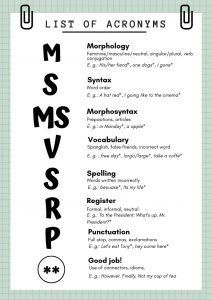
    To make it easier to understand and correct the text, the best way is to present a list of acronyms used for the correction at the beginning of the course in order to guide the revision of the text.

    List of acronyms for writing correction
    List of acronyms for writing correction

    Above you can download for free the PDF of the form I have prepared for my students.

    Enjoy your writing!

  • Canta che ti passa! Nina Zilli – 50mila

    Canta che ti passa! Nina Zilli – 50mila

    Una delle mie passioni è la musica e adoro usarla in classe per insegnare le lingue.

    Oggi presento una canzone di Nina Zilli insieme a Giuliano Palma, 50mila.

    Ero alla ricerca di una canzone per allenare l’indicativo presente e, come sempre, Alma edizioni è venuta in mio soccorso. Come risorsa gratuita del nuovo Canta che ti passa!, il loro libro di attività basato sulle canzoni italiane, presenta proprio 50mila di Nina Zilli.

    L’attività, scaricabile in PDF, è pensata per gli alunni di livello A2 e propone il ripasso del temuto verbo piacere, dell’imperativo negativo e dei numeri cardinali.

  • Come correggere la produzione scritta

    Come correggere la produzione scritta

    La produzione scritta è una delle abilità fondamentali da sviluppare quando si apprende una nuova lingua. Purtroppo, è anche una delle più difficili da migliorare e, soprattutto, da correggere.

    Negli anni ho provato come insegnante molti metodi, ma nessuno mi ha mai soddisfatto perché non riuscivo a verificare e seguire il progresso dei miei alunni.

    Il punto di svolta è avvenuto quando da insegnante sono diventata -di nuovo!- alunna: la mia prof di francese utilizzava questo metodo per correggere i nostri compiti per il livello B1. Io, da alunna, notavo i miglioramenti poco a poco e questo mi stimolava a continuare a scrivere e a sforzarmi.

    Ma in cosa consiste questo metodo?

    Semplicemente, è una forma diversa di correggere: invece di presentare la correzione, si sottolinea l’errore classificandolo. In questo modo l’alunno non è perso a pensare al tipo di errore fatto e a come correggerlo, ma è già instradato verso la possibile soluzione. All’alunno viene poi chiesto di correggere il testo seguendo le indicazioni dell’insegnante. Non sempre l’alunno arriva subito alla soluzione, ma sarà sicuramente più facile identificare e correggere lo sbaglio.

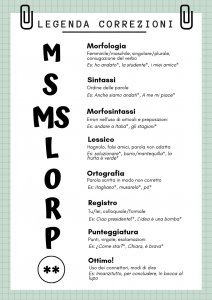
    Per facilitare la comprensione e correzione del testo, il miglior modo è presentare all’inizio del corso una legenda delle correzioni in modo da poter guidare la revisione del testo.

    Clicca per scaricare il PDF

    Qui sopra potete scaricare gratuitamente il PDF della scheda che ho preparato.

    Buon lavoro!

  • Kiran Desai – The Inheritance of Loss

    Kiran Desai – The Inheritance of Loss

    he Inheritance of Loss is available on Amazon.com
    The Inheritance of Loss is available on Amazon.com (affiliated)

    The following article is a short essay and review realised as part of a take-home exam for Postromantic Materialism course held at the University of Leuven in 2014-2015. You can also read an essay about NW by Zadie Smith and The Art of Fielding by Chad Harbach.

    Discuss the novel’s epigraph, Jorge Luis Borges’s “Boast of Quietness”.

    In Boast of quietness (Jactancia de quietud in Spanish) Borges speaks about the inevitability of time and ponders on the identity of people who migrated. Borges was from Argentina and lived in Europe for several years. Between 1923 and 1929 he wrote a lot about his Argentinian roots and about Buenos Aires too.

    Boast of Quietness is a poem of the collection Luna de enfrente (1925). This poem is focused on the opposition between “the ambitious”, people who have not moved from the city and plan their entire life there, and the poet, who speaks not only for himself but for all migrants too. The poet has clarity about only two things of his future: his life and his death. The ambitious never rest and do not have a bright viewpoint on humanity and homeland. In Borges’s opinion, these two abstract concepts corresponds to clear representations (“My humanity is in feeling we are all voices of the same poverty”, line 8; “My homeland is the rythym of a guitar, a few portraits, an old sword”, line 10). Borges “proclaims the inevitability of temporal existence (“Time is living me”, line 12)” (Jenckes, 2007:24) and “the poet’s passage through time is not in the name of anything, not even himself (“My name is someone and anyone”, line 15)” (2007:24).

    The epigraph of Boast of Quietness is used as a poetic example of people who go back and forth between cultures, but they manage not to lose their own identity.

    The author of The Inheritance of Loss portrayed different characters for her novel: Jemubhai, a student of higher education in London, Biju, an illegal immigrant in the United States, and Sai, an anglicized girl living in India with her grandfather. The estrangement coming from a migration experience is a recurrent topic in the post-colonial and migration literature. Desai managed to build a novel in which not only the immigrant is perceived as different, but also the inhabitants who become different after being exposed to another culture, unfairly detected as superior.

    In an interview of 2010[1], the author Kiran Desai is asked why she chose the Borges’s poem Boast of Quietness. She answered:

    This poem reflects the souls of the characters in the novel well. When you go to another country as a migrant, there are difficulties that you experience. The real important thing isn’t just your own story. There are many people’s stories like yours, and there are people who share the same fate, just as there are many books in a genre on library shelves. But you tell your own story. I selected this poem because it conveys similar feelings to readers. In the same way, when you look at the migration stories of Latin Americans and Mexicans, you can feel the parallels between all migrants’ stories. For this reason, Borges is a writer in whom I have a lot of trust in when it comes to conveying those feelings. (see note 1)

    In the same interview, she states:

    Being a migrant forces you to be creative because in one way or another you have a motivation […]. Your world and the environment you are in are changing, and this always makes you a more creative person. […] There is a light feeling of loss created by the migration feeling.

    The author remembers another time Borges’s words in Boast of Quietness: “I walk slowly, like one who comes from so far away he doesn’t expect to arrive” (line16).

    Bibliography

    Kiran Desai, The Inheritance of Loss, Grove Press, 2006

    Jorge Luís Borges, Boast of Quietness. Also consulted: “Jactancia de quietud”, Luna de

    enfrente, Editorial Proa, Buenos Aires, 1925.

    Kiran Desai: you are what you read, Sunday’s Zaman, published online September 12,

    2010. Consulted on December 7, 2014. URL: http://www.todayszaman.com/arts-

    culture_kiran-desai-you-are-what-you-read_221398.html

    Kate Jenckes, Reading Borges after Benjamin: Allegory, Afterlife and the Writing of

    History, Suny Press, 2007

    Nazneen Khan, Ravi Jauhari, Aspects of immigration and diasporic sensibility in Kiran

    Desais’s The Inheritance of Loss, Lapis Lazuli –An International Literary Journal, Vol.I, Issue.I, July 2011. URL: http://pintersociety.com/wp-content/uploads/2012/01/paper25.pdf


    [1] Kiran Desai: you are what you read, Sunday’s Zaman, published online September 12, 2010. Consulted on December 7, 2014. URL: http://www.todayszaman.com/arts-culture_kiran-desai-you-are-what-you-read_221398.html

  • “Ne” : come e quando si utilizza – vol. 2

    “Ne” : come e quando si utilizza – vol. 2

    Ogni professore di italiano per stranieri si sarà trovato, prima o poi, a dover rispondere a questa domanda:

    Ma quando uso “ci” e quando uso “ne”?

    Sicuramente avrete iniziato a sudare freddo. Essendo madrelingua, il meccanismo per capire dove e quando mettere i due pronomi è automatico.

    Ma come spiegarlo a chi sta studiando l’italiano e non ha queste particelle nella sua lingua?

    Prima di tutto, calma e sangue freddo.

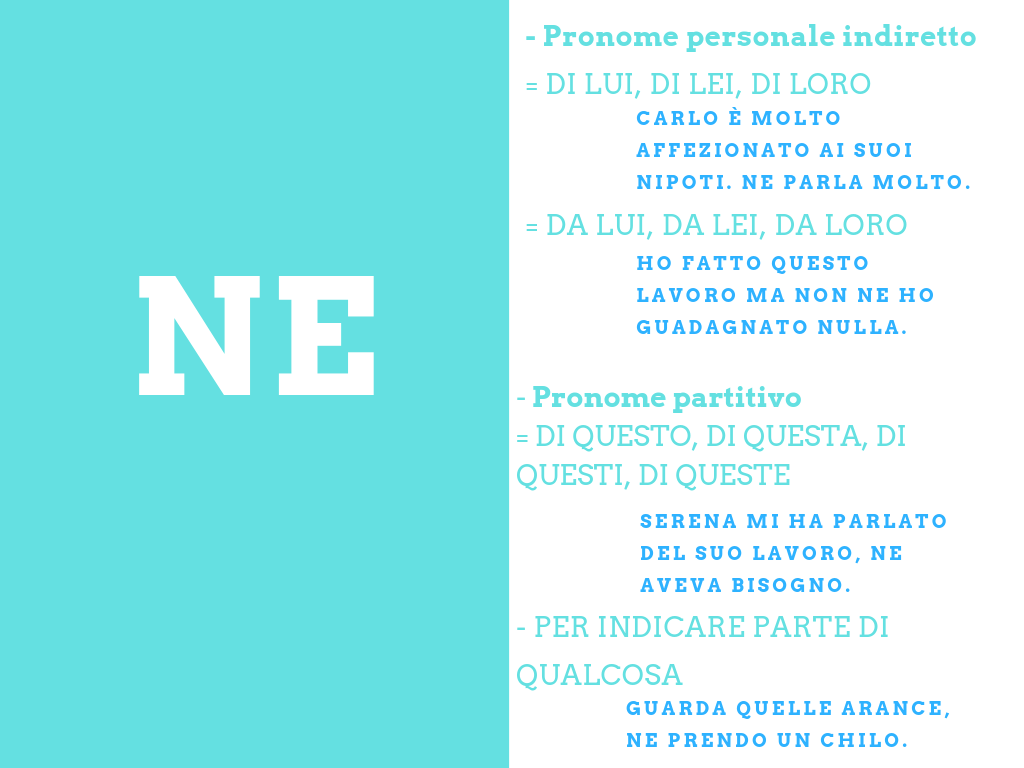
    Lo schema qui sotto ne semplifica la spiegazione:

    Gli studenti apprezzano la chiarezza: presentate uno schema (come quello qui sopra) con pochi esempi, ben chiari, e preparate schede con frasi da completare. Se non avete tempo, una facile e ben preparata è quella della Loescher, che trovate qui.

  • Sant’Apollinare Nuovo – Lo splendore del mosaico tra culto ariano e cattolico

    Sant’Apollinare Nuovo – Lo splendore del mosaico tra culto ariano e cattolico

    L’antica basilica palatina dell’imperatore Teodorico è una delle chiese più affascinanti di Ravenna, sia per la sua storia che per i misteri che si celano dietro alle sue mura.

    Prima di tutto la sua natura non è ancora chiara: fino a qualche anno fa si pensava che fosse la chiesa “privata” di Teodorico e della sua corte, data la vicinanza con l’enigmatico palazzo.
    La basilica, infatti, fu costruita nel V secolo da Teodorico e decorata secondo i canoni ariani. A questo periodo risalgono le decorazioni musive della chiesa, che hanno subito modifiche nel corso dellariconversione al culto cattolico nel VII secolo. Ci sono alcuni elementi bizzarri che lo ricordano: vedete le mani che sporgono sulle colonne della rappresentazione del palazzo di Teodorico? Ecco, parliamo di quello! Nella riconversione al culto cattolico molti elementi ariani -come i riferimenti alla corte dell’imperatore- vennero tolti o “corretti”.
    Le processioni rappresentate ai due lati della navata principale erano inizialmente le processioni dei cortigiani di Teodorico, trasformati poi in martiri e vergini con l’inserimento dei nomi e delle corone auree sulla testa dei pellegrini.

    La chiesa venne poi dedicata a Sant’Apollinare per la presenza delle reliquie del primo vescovo Ravenna, trasportate nel IX secolo da Sant’Apollinare in Classe.

    Ciò che richiamerà di certo la vostra attenzione è la presenza di vari stili decorativi: il mosaico originale del V secolo si trova accanto al soffitto a cassettoni di inizio ‘600 e alle decorazioni barocche un tempo coperte e di recente ritornate visibili.

    La basilica è però importante per le testimonianze musive che sono giunte quasi intatte fino a noi.
    Sopra le colonne, su tre livelli, si estende il più lungo ciclo musivo dell’antichità che si apre con la celebre rappresentazione del porto di Classe e della parte opposta del palazzo di Teodorico.
    Segono poi le processioni dei martiri e delle vergini che, come abbiamo detto, originariamente rappresentavano la corte di Teodorico. Le processioni culminano verso l’abside con Cristo sul trono da una parte e i Re Magi che portano i doni al bambino Gesù e Maria dall’altra.

    Nella fascia superiore ritroviamo delle rappresentazioni di santi e profeti, mentre in quella più alta si intravedono scene della vita di Cristo, alcune delle meglio conservate al mondo. Non sono facili da distinguere e da contestualizzare vista l’altezza a cui si trovano (l’ideale per poterle apprezzare al meglio è di certo avere con sè un binocolo o uno zoom) ma sono splendide ed arricchiscono la decorazione con numerosi dettagli.

    Sant’Apollinare Nuovo è una chiesa che più di altre racconta il trascorrere del tempo, l’avvicendarsi delle popolazioni, dei culti, degli stili, in un continuo processo di fusione ed arricchimento.

    Quest’articolo è stato pubblicato su ravennacityguide.it il 5 aprile 2016.