Categoria: Ricerca

  • La obra de Elsa Morante en la prensa española

    La obra de Elsa Morante en la prensa española

    Acaba de publicarse un artículo que es extraído de la tesis doctoral que estoy a punto de terminar, La obra de Elsa Morante en España.

    En el artículo publicado por la revista de la Universidad de León Estudios humanísticos. Filología presento un análisis de las ocurrencias del nombre de Elsa Morante en algunos periódicos españoles.

    El artículo se puede descargar aquí.

  • Coprifuoco: etimologia comparata

    Coprifuoco: etimologia comparata

    In questo anno delicato in cui le nostre vite sono cambiate profondamente, anche la lingua ha subito dei cambiamenti. Ci siamo abituati a termini stranieri riadattati (o meno) al nostro idioma.
    Non abbiamo paura di usare parole come lockdown, smart-working, e-learning, drive-in e drive-through, solo per citarne alcune. Altre soffrono un mutamento semantico: ricevere un messaggio come “Sono positivo” adesso ci fa paura, mentre fino a qualche mese fa dava un messaggio di speranza. Questi cambiamenti sono normali nelle lingue, dato che esse sono lo strumento che gli esseri umani usano per esprimersi. Lo racconta Vera Gheno, sociolinguista, in un’intervista per Wired:


    Tra lingua e società esiste sicuramente uno stretto rapporto, che si muove, però, in entrambe le direzioni. Da una parte, la lingua registra ogni cambiamento sociale e ne conserva traccia: quando ci troviamo di fronte a un concetto nuovo, abbiamo bisogno che la nostra lingua si modifichi per poterlo esprimere e quindi nascono parole nuove; oppure accade che parole che prima avevano un significato lo cambino e lo adattino a nuovi contesti (è il fenomeno che in linguistica si chiama slittamento semantico, o risemantizzazione funzionale). Ma accade anche che sia la lingua a influenzare il nostro modo di percepire la realtà, mettendone a fuoco alcuni aspetti che, senza una parola o un’espressione di riferimento, resterebbero sullo sfondo e sarebbero meno percepibili. Questo scambio bidirezionale tra lingua e società avviene di continuo ed è il segno di una lingua efficace e vitale, che riesce ad adattarsi alla realtà e a rispecchiarla.

    Vera Gheno, sociolinguista

    Il campo lessicale della guerra, soprattutto nel primo momento della pandemia, ci è servito per descrivere il tragico momento che iniziavamo a vivere. Medici e infermieri in trincea, in prima linea erano prima pronti a combattere, mentre ora sono stremati dalla battaglia.

    Nelle ultime settimane è saltato alla cronaca l’uso della parola coprifuoco: linguisticamente, in italiano è una parola composta dal verbo “coprire” e dall’oggetto “fuoco”: rende bene l’idea di spegnere delle fiamme, evidentemente per evitare mali peggiori. Ci basta consultare il vocabolario Treccani per scoprire la storia del termine:

    Usanza medievale per cui, a una determinata ora della sera, gli abitanti di una città erano tenuti a coprire il fuoco con la cenere per evitare incendi; anche il segnale (suono di campane o altro) con cui s’intimava il coprifuoco

    Treccani.it

    Il fuoco, di solito portatore di vita, nelle città medievali era spesso legato alla distruzione, così come il suono delle campane spesso avvisava dei possibili saccheggi.

    Il dizionario Treccani ci presenta anche la possibile etimologia della parola, che pare non essere direttamente italiana, ma derivata dal francese coverfeu. Il termine italiano sarebbe così un prestito linguistico adattato alla lingua italiana traducendo i due termini che costituiscono l’espressione. Un’altra lingua che ha adottato il termine francese, questa volta adattando la parola alla pronuncia, è l’inglese: da coverfeu a curfew, come spiega il dizionario Merriam-Webster.

    È interessante notare che in non tutte le lingue europee sia presente l’idea di coprire il fuoco per evitare gli incendi. In spagnolo il termine è toque de queda, simile al portoghese toque de recolher, ed entrambi richiamano il lessico militare. Il “toque” a cui si fa riferimento è il suono di una sirena o di una campana che, in circostanze straordinarie, segnalava alla popolazione l’obbligo di rimanere a casa, in spagnolo “quedarse”, o di fare ritorno alle abitazioni, come può ricordare il “recolher” portoghese.

    In euskera possiamo trovare tre espressioni: etxeratze-agindu (“etxe”, casa, “ra”, verso, “tze”, per, “agindu”, ordine: ordine per tornare a casa), kera-dei (“kera”, conclusione, “dei”, richiamo: richiamo alla conclusione) e isildei (“isil”, silenzio, “dei”, richiamo: richiamo al silenzio). Tutte e tre ci ricordano il richiamo militare o l’obbligo di cessare le attività.

    In tedesco, coprifuoco si può tradurre con ausgangssperre, letteralmente “barriera all’uscita” o ausgehverbot, divieto di uscire. In sloveno il termine è policijska ura, mentre in polacco è godzina policyjna. In entrambi i casi, il riferimento all’”ora della polizia” fa venire la pelle d’oca e ci ricorda il passato difficile dei paesi dell’Est Europa.

    Potremmo andare avanti per ore parlando dell’etimologia della parola “coprifuoco” nelle diverse lingue: possiamo però trovare dei punti in comune. La maggior parte delle lingue rimanda a un lessico puramente militare, legato all’obbligo di rimanere in casa, mentre in quelle che hanno adottato il termine dal francese rimane il significato di misura preventiva per evitare mali maggiori.

    In ogni caso, è sempre una misura obbligata in un momento di emergenza: non ci deve sorprendere l’ostilità che questo termine suscita in tutto il mondo perché risveglia, anche incoscientemente, ricordi della nostra memoria collettiva.

  • Alasdair Gray – Lanark

    Alasdair Gray – Lanark

    The following article is a short essay and review realised as part of a take-home exam for Postromantic Materialism course held at the University of Leuven in 2014-2015. You can also read an essay about To the Lighthouse by Virginia Woolf, NW by Zadie Smith, The Art of Fielding by Chad Harbach , The Inheritance of Loss by Kiran Desai, The Heat of the Day by Elizabeth Bowen and A Handful of Dust by Evelyn Waugh.

    The novel tries out a blend of realism and fantasy. Read up on the genre of fantasy and comment on specific occurrences of the fantastic (e.g. the phenomenon of dragonhide).

    In general, when we think about the genre of fantasy we imagine supernatural forces, unreal worlds, invented creatures. The notion of “fantastic” in a more realistic application to the literature was presented for the first time by the structuralist critic Tzvetan Todorov in his book  The Fantastic: A Structural Approach to a Literary Genre (1973). To summarize his idea, a novel is fantastic whenever it creates an hesitation of characters and, above all, readers when it raises questions about reality. The hesitation of the reader is the first condition of fantastic; the second is the hesitation of a character and the third condition is that the reading of the text should not be poetic or allegoric. One example of this incredulity coming from the hesitation of the reader can be found in the spanish novel El cuarto de atrás by Carmen Martín Gaite, reminding the reader The Metamorphosis by Franz Kafka. In Kafka’s novel, the protagonist Gregor Samsa wakes up being a monstrous creature, while in Martín Gaite’s short story is all built around the female protagonist, a man dressed in black and a beetle which appears in her apartment when the man is not there.

    Lanark by Alasdair Gray seems to enter in this series of fantasy book with a realistic approach of the writer. Realism and fantasy coexist in this novel, structured in a way to confuse the reader, starting with “Book three” and followed by a “Prologue”.

    “If reality is constructed verbally, through a text, Scottish texts are often seen as hybrids, a mixing and matching of different traditions and genres, fact and fiction, Gothic fantasy and social history, romance and realism. Bernstein notes how this mixing of genres is not only a characteristic of Scottish fiction but a central concern in Gray’s work: “It should thus come as no surprise to find frequent mixing of genres in Gray’s writing, and though full-blown fantasy will not always be part of the aggregate, some blending… appears inevitable”. (Kacvinsky:791)

    From the first pages of the book the reader understands that the novel will not be easy to interpret. The references to an unnatural presence in the setting of the novel are inserted soon after the presentation of the protagonist and continue throughout the novel as infectious illnesses:

    I asked what the hard patch was. He said, “We call it dragon-hide, a name more picturesque than scientific, perhaps, but the science of these things is in its infancy. You can dress now.” (Gray:23-24)

    The fantastic element is always presented in a self-coherent setting, as in page 36: ““You’ve got dragonhide! Your shoulderblades are covered!” “Does that excite you?” “I have it too!”” (Gray:36). In this dialogue , Rima and Lanark could exchange the word “dragonhide” with “tatoo”, for instance, and everything will continue to seem natural and realistic. Another representation of the fantastic is in the “Prologue”, from page 108 to 117. The fluidity of the episode between Rima, Lanark and the Oracle is complicated by the continuous shift between the narrating person. Also the hallucinations do not help in understanding who is thinking what: “All the time they saw through the window people moving in the rooms and streets of a city, though sometimes there were glimpses of mountains and sea, and at last huge waves moving slowly at the foot of a cliff” (Gray, 1981:111).

    As perfectly pointed out in Lousbergh’s work,

    “As for the themes fantasy introduces, Lanark features many, such as transformations and dualism and the motifs of the ghost, the double, enclosures, cannibalism and hallucination. […] The one thing they all have in common, is obviously the fact that they enhance doubt and hesitation thematically. Many of the interpretative questions Lanark does not answer relate to exactly these themes and motifs, for instance: Is Lanark the afterlife ghost of Thaw and/or is he Thaw’s double or other self? Does Thaw kill marjory, or it is merely an hallucination? All motifs question the trueness of the truth and make both reader and character doubt reality. Even Lanark himself asks the Oracle if Thaw really killed Marjory or hallucinated it […] Fantasy than holds up the question of what is real and what not and does not answer it”. (Lousbergh, 2003:73)

    It is easy to recognize the idea of fantasy in the chapters where Lanark is protagonist. At the Institute, for instance, the absurdity of some scenes -like the explosions of patients or the cure given by doctors- immediately lead the reader to an imaginary setting or even a dream. But also in Thaw sections, the more realistic ones, we can see some issues of the fantastic genre, closer to the idea of hesitation explained by Todorov. “thaw struggles with perspectives” (2003:77) and so we can say that “realism is thus overpowered by fantasy” (2003:77)

                While reading Lanark we can be sure of only one thing: there is no real reality, as well as there is no fantastic fantasy. The structure of the novel, the uncertainty of time, the balance between a realistic world and an imaginary town like Unthank -though really close to the representation of Glasgow- keep the reader in a state of uncertainty which is soon reflected in the own life of the reader. Is it possible to conceive fantasy present in reality only in real life?

    “Like so much modernist fiction, Lanark in this way continues to demonstrate that the temporal systems which constrain and commodify twentieth-century experience can still be escaped or reordered in art, imagination, and narrative, if hardly any longer in fact. Lanark is by no means alone among postmodernist novels in following on from modernism in this way”. (Stevenson:133)

    Bibliography

    Alasdar Gray, Lanark, 1981. PDF version.

    Donald P. Kaczvinsky, “Making up for Lost Time”: Scotland, Stories, and the Self in Alasdair Gray’s “Poor Things” in Contemporary Literature, Vol. 42, No. 4 (Winter, 2001), pp. 775-799, University of Wisconsin Press

    Randall Stevenson, “Greenwich Meanings: Clocks and Things in Modernist and Postmodernist Fiction” in The Yearbook of English Studies, Vol. 30, Time and Narrative (2000), pp. 124-136, Modern Humanities Research Association

    Goedele Lousbergh, Who’s fooling who? Power, authority and how to undermine them in Alasdair Grays’ Lanark: a life in four books, KUL. Faculteit letteren. Departement literatuurwetenschap. Engelse literatuur, 2003


  • Evelyn Waugh – A Handful of Dust

    Evelyn Waugh – A Handful of Dust

    The following article is a short essay and review realised as part of a take-home exam for Postromantic Materialism course held at the University of Leuven in 2014-2015. You can also read an essay about To the Lighthouse by Virginia Woolf, NW by Zadie Smith, The Art of Fielding by Chad Harbach , The Inheritance of Loss by Kiran Desai and The Heat of the Day by Elizabeth Bowen.

    Waugh borrows his title from T.S. Eliot’s “The Waste Land,” one of the foundational texts of (English) Modernism. Investigate the notion of Modernism and discuss its relevance to Waugh’s work.

    Starting from the incipit of the novel, Waugh declares his idea of writing something as much closer as possible to the real human nature. He quotes line 27-30 of the first part of The Waste Land, titled the Burial of the Dead. It is a clear reference to the plot of the novel: the story focuses on a couple, Tony and Brenda Last. After their son’s death in a car accident everything changes. Brenda demands the divorce and Tony leaves for an expedition to Brazil where, after being rescued by Mr. Todd, is forced to read aloud Dickens’ novels to him. Tony is declared dead and Brenda marries an old friend. This very brief summary can’t provide an overview of the several themes in the writing. “The Modernist impulse is fueled in various literatures by industrialization and urbanization and by the search for an authentic response to a much-changed world” (see Encyclopedia Britannica Online). Critics tend to divide the modernism into two periods: the pre-modernism, with Joseph Conrad’s Hearth of Darkness novel as milestone, and postwar modernism taking as a major example the Eliot’s long poem The Waste Land. It is not a coincidence that these two major works come together in Waugh’s novel. It could be related with the idea of defining in literature how a deeply changed world influenced the lives of normal people. Modernism is often related with the historical period between the two world wars, when disillusion and fragmentation broke the reception of a novel as an entertaining piece of art. In modernism perspective, modeling and the subject matter more than the general plot or idea of a novel.

    Morality also plays a big role in modernism and it is a highly deepened topic in Waugh’s novel, lying into the opposition between the modernism -represented by The Waste Land and Heart of Darkness– and the artificial and sentimental view of the society.

    Bibliography

    S. Eliot, The Waste Land, 1922. Consulted online on Project Gutenberg’s website http://www.gutenberg.org/files/1321/1321-h/1321-h.htm, 25th October 2014

    Encyclopaedia Britannica Online, Modernism (art), http://www.britannica.com/EBchecked/topic/387266/Modernism, 25th October 2014

    http://www.connotations.uni-tuebingen.de/lobb01312.htm
    http://www.connotations.uni-tuebingen.de/stannard01413.htm

  • Virginia Woolf – To the lighthouse

    Virginia Woolf – To the lighthouse

    The following article is a short essay and review realised as part of a take-home exam for Postromantic Materialism course held at the University of Leuven in 2014-2015. You can also read an essay about NW by Zadie Smith, The Art of Fielding by Chad Harbach , The Inheritance of Loss by Kiran Desai and The Heat of the Day by Elizabeth Bowen.


    The focus on Lily Briscoe makes To the Lighthouse an instance of the so-called Künstlerroman. Read up on this genre and select and comment on relevant passages from the text.

    The idea of künstlerroman, the German expression for “artist’s novel”, proceeds from the more general bildungsroman, or “apprenticeship novel”. The künstlerroman focuses on “the development of an individual who becomes—or is on the threshold of becoming—a painter, musician, or poet” (see Encyclopædia Britannica Online). Tipically, the künstlerroman is related to the first author’s steps into the literature and to his literary autobiography. The difference between the bildungsroman and the künstlerroman also lies in the destiny the author imagines for his character. While the hero of the apprenticeship novel “often dreams of becoming a great artist but settles for being a mere useful citizen, the Künstlerroman usually ends on a note of arrogant rejection of the commonplace life” (see Encyclopædia Britannica Online). The most significant example is Joyce’s A Portrait of an Artist as a Young Man (1916), also because the aim of writing a künstlerroman is already explicit in the title of the novel.

    The artist, like the God of creation, remains within or behind or beyond or above his handiwork, invisible, refined out of existence, indifferent, paring his fingernails


    Joyce, 1916, The Portrait of an Artist as a Young man,ch. 5

    Other examples of künstlerroman can be Gabriele d’Annunzio’s Il piacere (1888), Marcel Proust’s À la recherche du temps perdu (1913), John Fante’s Ask the dust (1939) -just to allude to some other acclaimed novels from different countries.

    As regards Virginia Woolf’s oeuvre, To the Lighthouse is not her only exemplification of bildungsroman or künstlerroman. The voyage out (1915) is the first Woolf’s novel and is considered her first example of künstlerroman,since it outlines the life of Rachel Vinrace, a musician who travels to South America and there finds her love, an aspiring writer. Orlando: a biography (1928) is another instance of künstlerroman: the protagonist is young noble and aspiring poet of the Elizabethan period. Some authors see Orlando more as a “satirical künstlerroman, exploring the gender politics of poetics and subjectivity across the ages” (Goldman, 2002:319).

    To the Lighthouse (1927) is “a self-reflexive, feminist künstlerroman” (Goldman, 2002:318). “To the Lighthouse is a novel about memory and desire” (Raitt, 1990:23). A lot has been said about this highly poetical and autobiographical novel by Virginia Woolf. Lily Briscoe is a young woman, a painter, struggling in a post-victorian society for her identification as an independent woman. She is invited to spend some time with the Ramsay’s family in their summer home on the Isle of Skye, in the Hebrides, together with other family friends. She stays at a window, trying to complete her painting of Mrs. Ramsay and her son James, but throughout the first chapter she seems unable to focus on her work. “It was in that moment’s flight between the picture and her canvas that the demons set on her who often brought her to the verge of tears and made this passage from conception to work as dreadful as any down a dark passage for a child” (Woolf, 1927: The Window, 4). For Lily Briscoe the drawing is not a mere portrait, but the representation of a constant conflict between herself and the contemporary society, represented by Charles Tansley, a family friend: “Charles Tansley used to say that, she remembered, women can’t paint, can’t write” (Woolf, 1927: The Lighthouse, 4). This feeling of not belonging to the right situation prevent her not only from working at the canvas, but also to express her real emotions to Mrs. Ramsay: “and it was then too, in that chill and windy way, as she began to paint, that there forced themselves upon her other things, her own inadequacy, her insignificance” (1927: The window, 4).

    To the Lighthouse,an autobiography

    It is easy to recognize To the Lighthouse as an autobiography. Lily Briscoe succeeds in completing the portrait ten years later, after the First World War and the death of Mrs. Ramsay and of her sons Prue and Andrew. Virginia Woolf accomplishes to recreate her complex family situation almost thirty years after her parents’ passing away. For her, “the ‘syllabing’ of To the Lighthouse was a process of involuntary recall as well as of literary creation, and was therefore doubly unexpected for Woolf” (Raitt, 1990:34). In her diary, Virginia Woolf wrote “I used to think of him & my mother daily; but writing The Lighthouse, laid them in my mind”(Bell, 1977:III, 28 November 1928, 208). The writing of To the Lighthouse and the conclusion of the painting are the final expression of artistic success. Virginia Woolf and her alter-ego Lily always wanted to deeply go through their suffering as women before as artists.

    The “H” structure of the novel reminds to this idea of going through a journey to survive the internal struggles of oneself. The first part of the novel, The window, can be seen as the acknowledgement and the subsequent reflection about the obstacles that don’t allow to complete a piece of art, for Lily, or to easily live a normal life after facing parents’ death, for Woolf. The second part, Time passes, is the bridge of the “H” and the shortest chapter of the novel. The thinking shifts to the ineludible passing of the time which cannot help to solve any inner conflict. “But what after all is one night? A short space, especially when the darkness dims so soon, and so soon a bird sings, a cock crows, or a faint green quickens, like a turning leaf, in the hollow of the wave. Night, however, succeeds to night” (Woolf, 1927: Time passes, 3). Part three, The Lighthouse, is the depiction of a new state of the mind, finally free from the sorrows of too much years spent in the shadows of thinking not to be in the right place. “Lily squeezed her tubes again. She attacked that problem of the hedge. It was strange how clearly she saw her, stepping with her usual quickness across fields among whose folds, purplish and soft, among whose flowers, hyacinth or lilies, she vanished” (Woolf, 1927: The Lighthouse, 8). This quote evokes the words of Woolf’s diary about her mother and father, gently faded out of her constant but distressing thoughts.

    “With a sudden intensity, as if she saw it clear for a second, she drew a line there, in the centre. It was done; it was finished. Yes, she thought, laying down her brush in extreme fatigue, I have had my vision” (Woolf, 1927: The Lighthouse, 14). The painting is finally finished, the most confidential and painful novel has come to its final dot. Both Lily Briscoe and Virginia Woolf have concluded their masterpieces.

    Bibliography

    Encyclopædia Britannica Online, s. v. “Kunstlerroman”, accessed 15th October 2014.

    Document URL http://www.britannica.com/EBchecked/topic/325047/Kunstlerroman

    Goldman, Jane. “Woolf, Virginia (1882-1941).” British Writers: Retrospective Supplement

    1. Ed. Jay Parini. Detroit: Charles Scribner’s Sons, 2002. 305-323. Accessed on 17th Oct. 2014.

    Joyce, J., A Portrait of an Artist as a Young Man, 1916. Epub version by Project Gutenberg,

    accessed 15th October 2014. Document URL http://www.gutenberg.org/files/4217/4217-h/4217-h.htm

    Olivier Bell, A., The Diary of Virginia Woolf, Hogarth, London, 1977-84

    Raitt, S., Virginia Woolf’s To the Lighthouse, Harvester Wheatsheaf, 1990.

    Woolf, V., To the Lighthouse, 1927. Epub version by Project Gutenberg,

    accessed 7th October 2014. Document URL http://gutenberg.net.au/ebooks01/0100101.txt
  • Elizabeth Bowen – The heat of the day

    Elizabeth Bowen – The heat of the day

    The Heat of the Day is available on Amazon.com
    The Heat of the Day is available on Amazon.com (affiliated)

    The following article is a short essay and review realised as part of a take-home exam for Postromantic Materialism course held at the University of Leuven in 2014-2015. You can also read an essay about NW by Zadie Smith, The Art of Fielding by Chad Harbach and The Inheritance of Loss by Kiran Desai.

    Critically discuss the text’s deployment of notions of allegiance and inheritance, domesticity and community. Identify key passages and comment.

    As Corocoran states,

    The Heat of the Day, a story about entangled loyalties and treacheries -in war, in love and in relationships across the generations- is itself a generated out of a radical sense of destabilizations and disorientations. (Corcoran, 2004:168)

    It is to underline that the notions of allegiance, inheritance, domesticity and community are deeply modified by the context in which they develop: the war and a London destroyed by bombing.

    Characters yearn for a time when the family and its home could fulfill their need for purpose and identity, but they also suspect that this is never to be. Torn between romantic nostalgia for wholeness, security, and stability and denial of their often-disappointing history, they understand but ignore the way a perfectly knowable past foretells their difficult future. (Lassner, 1991:75).

    These notions are also intertwined in different ways throughout the novel: in chapter 15, for example, allegiance goes together with community. In chapter 5, community lies in the same field as domesticity and allegiance. Inheritance goes with community, and so on. As well as these notions intertwine between one another, the book also deepens the effects of the “big history” -World War I, the battle of Dunkirk in 1940, the bombing in London and so on- on the domestic lives: Victor, Stella’s husband, leaves her for his nurse who took care of him after he was wounded during WWI; also Robert was wounded and became lame after the battle of Dunkirk.

    During chapter 5, the protagonist, Stella, ponders on the changing behaviour of the inhabitants of London and the idea of community: “The wall between the living and the living became less solid as the wall between the living and the dead thinned” (Bowen, 1983:126); “each hoped not to die that night, still more not to die unknown” (1983:126) “[…] the indifference of the embattled city to private lives, the exiguousness and vagueness of everybody’s existence among the ruins could, but for Roderick, have made that easy” (1983:128).

    The war changes the priorities in a society, making everyone aware that the person sitting next to you could be your salvation or your sentence to death. “The boundaries between self and other, ally and enemy have collapsed” (Gildersleeve, 2014:124). Knowing “whom or what to believe” (Ritchie, 1974:61) is one of the central ideas of the novel: Stella goes against Robert to protect him, literally surrendering to Harrison. But she does not know who Robert really is, until chapter 15 when the discuss all past experiences together from a new point of view. At this point strongly steps in the idea of allegiance, not only from the point of view of Robert, now uncovered, but also from Stella’s view. Robert points out his idea of democracy and freedom: “Freedom. Freedom to be what?—the muddled, mediocre, damned. […] Tell a man he’s free and what does that do to him but send him trying to dive back into the womb?” (Bowen, 1983:379-380)

    The clearest references of the novel are the ones to allegiance: as it could be interpreted as a spy story, the loyalty to homeland is a basic assumption. Of course, the first idea we can make of this notion of spying comes from the relationship between Stella and Robert. The notion of allegiance also lies in the relationship between Stella and her son Roderick, a 19-year-old boy who becomes a soldier. Stella always fears to lose him but mainly his essence lost through the the presence in the army.

    For what nagged at her, what flickered into her look each time she confronted the soldier in battle dress, was the fear that the Army was out to obliterate Roderick. In the course of a process, a being processed, she could do nothing to stop, her son might possibly disappear. (Bowen, 1983:49)

    In chapter 15 Robert explains Stella the reason why she is mad at him: “What is repulsing you is the idea of ‘betrayal,’ I suppose, isn’t it?” (1983:379). Allegiance is a concept also present in the complicated relationship between England and Ireland. After his death, Cousin Francis cannot cross the sea to be buried in Ireland. We also read of bitter opinions about Ireland: “Ireland? Things may not be what they were in that unfortunate country, but you won’t get me to believe that chap [Cousin Francis] is an Irishman! So what was he up to there, I should like to know?” (1983:110).

    In this book we are far from the idea of domesticity we see, for example, in To the Lighthouse. Stella and Louie, female protagonists, are never described while doing some domestic work, as it always happened with Mrs. Ramsay. In the first part of the story Stella lives in Louie’s house, but for her this does not mean feeling safe or protected: she finds shelter in people: “What the inheritance came to be for Roderick, Robert was for Stella—a habitat” (1983:123).

    The two women also have a strange consideration of respect in a couple: the seem to look for partners for the sake of monogamy. Louie meets other men in order to remember better her husband, away for the war, while Stella sacrifices her own reputation not to reveal the real cause of the end of her marriage, maybe also for the delight of being considered a femme fatale.

    The notion of inheritance is soon related to Roderick: after Cousin Francis’ death, he inherits a property in Ireland:

    “As against this, Roderick now owned property he had never seen. Last May, he had inherited from a cousin of his father’s a house in the south of Ireland, Mount Morris, with which went about three hundred acres of land. Probate, likely to be retarded by the complication of Mount Morris’s being where it was, had not yet been” (1983:65).

    As he can leave for the war, Roderick also thinks about the possibility of dying.

    “Death could not estimate what it left behind it. […] Roderick reflected that, as things were, there would be nobody but his mother to be his heir, either: he felt this with chagrin both for himself and her—between them, they should have come to something further than this. He began to mutiny—which took the form of striking match after” (1983:443).

    This paragraph is particularly striking: a 19-year-old boy reflects not only about death, but also about material concepts related to one’s death, contemplating the possibility of his unnatural departure before his mother’s. 

    Bibliography

    • Bowen, Elizabeth, The Heat of the Day, Penguin Books, 1983. Quotes from a PDF version of the novel.
    • Corcoran, Neil. Elizabeth Bowen. The Enforced Return,  Clarendon Press, Oxford, 2004
    • Gildersleeve, Jessica. Elizabeth Bowen and the Writing of Trauma. The Ethics of Survival. Rodopi, Amsterdam-New York, 2014
    • Lassner, Phyllis, “Elegies of Loss and Dispossession.” Elizabeth Bowen: A Study of the Short Fiction. Twayne’s Studies in Short Fiction 27, pp. 75-96. Twayne Publishers, New York, 1991. 75-96.
    • Ritchie, Charles. The Siren Years: Undiplomatic Diaries 1937-1945, Macmillanm London, 1974


  • Guida all’indipendentismo catalano per italiani – Un anno dopo

    Guida all’indipendentismo catalano per italiani – Un anno dopo

    Ormai un anno fa è iniziato il Proces, quello che in catalano è il processo di dichiarazione di indipendenza dalla Spagna. A che punto siamo? C’è ancora interesse per l’indipendenza catalana?

    Il referendum dell’1 ottobre 2017: scacco al re

    L’1 ottobre 2017 è una data che verrà ricordata a lungo: il referendum per l’indipendenza della Catalogna viene celebrato tra non pochi problemi. Quel giorno gli occhi degli spagnoli erano rivolti alla regione catalana, consapevoli che nulla sarebbe più stato come prima. Era molto diverso dal referendum del 2014 convocato da Artur Mas –di cui parlo qui – se non altro perché in tre anni la popolazione è diventata molto più consapevole e indirizzata verso la dichiarazione di indipendenza.

    Tutti avrete visto le immagini di violenza per le strade catalane.

    Manifestazioni durante il voto del referendum catalano l’1 ottobre 2017 – El Periódico

    La Generalitat ha giocato uno scacco matto al governo spagnolo di Rajoy: il referendum non si poteva celebrare perché illegale –e approvato da una minoranza del parlamento catalano- e per questo motivo il governo centrale ha messo in campo anche troppe forze di polizia. Le manifestazioni non sono state pacifiche e la risonanza internazionale ha messo a dura prova Rajoy e il re Felipe VI, mostrando la Catalogna come vittima di un’oppressione fascista.


    Il contestato video Help Catalonia. Save Europe realizzato da Omnium Cultural


    I disordini e le colpe delle varie forze di polizia sono innegabili. Ma la situazione è sfuggita di mano più del previsto: il 10 ottobre Carles Puigdemont, ex presidente della Generalitat, ha in pochi secondi dichiarato e sospeso l’indipendenza.


    La dichiarazione unilaterale di indipendenza e l’art. 155

    La dichiarazione unilaterale di indipendenza è stata poi votata il 27 ottobre dal parlamento catalano, in una sessione con 70 voti a favore su 82 (di 135) parlamentari presenti. Con il voto si è dato il via alla “Ley de Transitoriedad” per permettere la creazione di organismi statali.

    La risposta del governo centrale non si è fatta attendere: il giorno successivo Mariano Rajoy dichiarava l’applicazione dell’articolo 155 della costituzione spagnola.

    Se una comunità autonoma dovesse attuare in una forma che attenta gravemente l’interesse generale della Spagna […] il Governo potrà attuare le misure necessarie […] alla protezione del sopra menzionato interesse generale

    L’interesse generale è stato protetto sciogliendo tutte le istituzioni catalane, convocando le elezioni per il 21 dicembre 2017 e arrestando i principale responsabili della dichiarazione d’indipendenza. Alcuni, come il vicepresidente Oriol Junqueras e la presidentessa del parlamento Carme Forcadell, sono stati arrestati. Altri, como Puigdemont stesso o la leader della CUP Anna Gabriel si sono rifugiati all’estero.

    Nuovi governi, vecchie vicissitudini

    Dopo vari mesi di incertezza,il 14 maggio Quim Torra viene eletto presidente della Generalit nel parlamento presieduto da Roger Torrent.


    Roger Torrent e Quim Torra – Ok Diario


    Da dicembre non si sono fatti grandi passi avanti per quanto riguarda la separazione dal Governo centrale. Se non altro, si è notato come lo “spettro” di Puigdemont sia sempre presente in Catalogna. I vari mesi di ritardo nella nomina di Torra sono dovuti alla ricerca di una modalità per dichiarare Puigdemont presidente, nonostante il mandato di cattura internazionale per il reato di secessione.

    Qualche sussulto si sta avendo proprio in questi giorni. Pedro Sánchez, presidente del governo spagnolo dopo la mozione di sfiducia al governo di Rajoy il 18 giugno scorso, ha ricevuto un ultimatum da Puigdemont e dai partiti indipendentisti che lo avevano appoggiato nella sua sfiducia. “Il periodo di grazia è terminato”, dichiarava l’ex presidente in un incontro alla delegazione catalana di Bruxelles.

    Una società spaccata in due

    Se le azioni politiche sono in stallo, le azioni rivendicative tra la popolazione civile si stanno moltiplicando.

    Come aveva dichiarato Puigdement di fronte al Parlamento catalano poco dopo le elezioni, il referendum dell’1 di ottobre ha segnato un prima e un dopo. Le relazioni tra la Generalitat e il governo centrale si sono inasprite ancora di più, ma soprattutto è aumentato l’astio tra catalani indipendentisti e non indipendentisti.

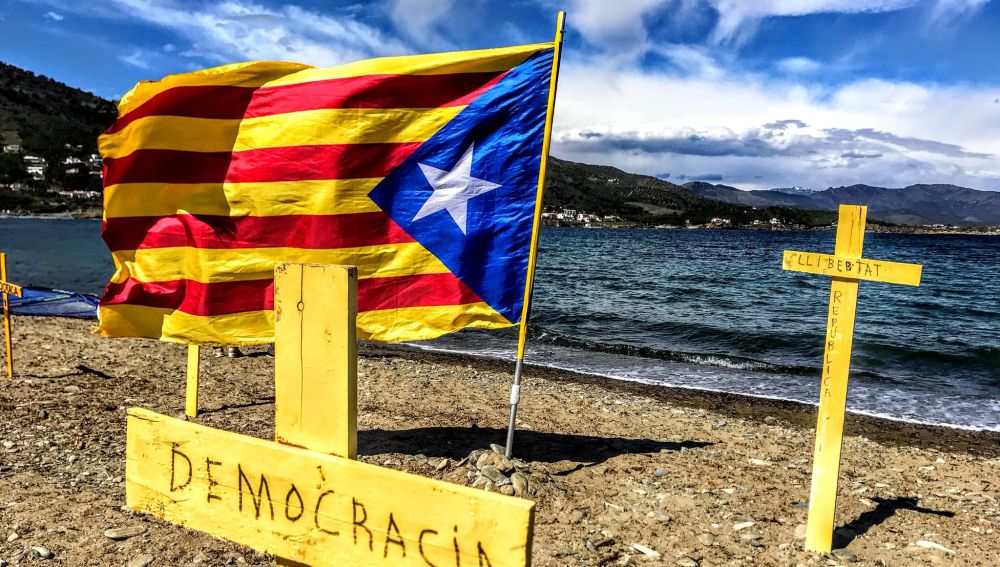
    Oltre alla estelada, la famosa bandiera indipendentista, il giallo e in particolare i fiocchi gialli sono diventati i simboli dell’indipendenza. Sono apparsi per la prima volta tra le sedute vuote del parlamento catalano, per riempire il vuoto dei presos polítics, gli arrestati per l’organizzazione del referendum e gli auto esiliati.


    I fiocchi gialli negli scranni vuoti del Parlamento catalano – Voz libre

    Con l’arrivo dell’estate, anche le azioni politiche si sono spostate al mare: sono apparse croci gialle in spiaggia, simbolo della libertà e della democrazia perdute.

    Le croci gialle per l’indipendenza – La Sexta

    Nei numerosi video pubblicati sulle reti sociali ci sono le testimonianze di persone catalane che si attaccano duramente, chi per l’indipendenza dalla Spagna e chi per il diritto di sentirsi spagnoli in terra catalana.


    https://www.youtube.com/watch?v=8rSbn2m6mt8


    I toni tra politici non sono da meno: ha destato molto scalpore che il sindaco di Canet de Mar, Blanca Arbell, abbia proibito a Inés Arrimadas, deputata anti-indipendenza per Ciudadanos del Parlamento Catalano, di tenere un comizio nella sua città.


    https://www.youtube.com/watch?v=8xJaUBavhMw

    La Arrimadas ha interpretato ciò che è successo come “l’ennesima prova della separazione della società civile in Catalogna”.

    Ciò che richiama l’attenzione è la postura del governo catalano nei confronti degli atti rivendicativi: mentre passano inosservati quelli degli indipendentisti, i non indipendentisti rischiano multe e l’arresto per aver togliere simboli indipendentisti.

    Uno dei gesti che più scalpore ha suscitato è stato in occasione dell’anniversario dell’attentato a Barcellona del 17 agosto 2017. Le autorità avevano chiesto di non politicizzare una celebrazione contro il terrorismo, ma poche ore prima della manifestazione è apparso un cartellone su un palazzo al centro della capitale catalana: il re Filippo VI non era il benvenuto in Catalogna.


    Il re non è il benvenuto nei paesi catalani – El Periódico

    Il ritorno dell’art. 155

    Tutto ciò non fa che inasprire di nuovo i rapporti tra Generalitat e governo centrale. Ciudadanos ha richiesto a Pedro Sánchez, presidente del governo spagnolo, di rimettere in marcia i meccanismi dell’articolo 155 della costituzione.

    Nelle prossime settimane assistiremo, ancora una volta, alle richieste del governo catalano nei confronti di quello spagnolo. Pedro Sánchez riuscirà a mantenere intatte le autorità spagnole?

  • Cultural and Creative Cities Monitor: uno strumento utile per misurare la creatività delle città

    Cultural and Creative Cities Monitor: uno strumento utile per misurare la creatività delle città

    Il Centro di ricerca della Commissione Europea, il Joint Research Centre, negli scorsi mesi ha sviluppato e aggiornato il Cultural and Creative Cities Monitor. Per confrontare le performance delle città sono stati elaborati dati di 168 città in 30 paesi dello spazio economico europeo, selezionate in base al loro impegno nella promozione della cultura e della creatività.

    In questo video (realizzato dai Panebarcos!) si spiega in breve che cosa sia il Monitor.

    Cosa rende culturale e creativa una città?

    Sono stati presi in considerazione 29 indici di analisi statistica, raggruppati in tre gruppi principali per definire le città: la loro vitalità culturale, la presenza dell’economia creativa e quanto è stimolante l’ambiente circostante.

    Ad esempio, per la vitalità culturale non si misura solo il numero di attrattori culturali, ma anche la partecipazione culturale agli eventi e la soddisfazione rispetto ai servizi culturali. Per quanto riguarda l’economia creativa, sono stati inclusi il numero dei lavori nella cultura, nella comunicazione e nell’intrattenimento oltre che al numero di brevetti presentati. Grande importanza viene data all’ambiente circostante con ben 12 indicatori. Vengono inclusi dati relativi al numero di laureati, ma anche alla presenza di stranieri, alla loro integrazione, al livello di tolleranza. Importanti anche i trasporti che vengono analizzati tramite il numero di passeggeri dei voli, di treni diretti per le città e l’accessibilità delle strade. Un indicatore viene anche dedicato alla percezione della qualità della governance della città.

    La città culturale e creativa perfetta non esiste

    L’analisi dei dati ha rivelato che una città ideale dal punto di vista culturale e creativo non esiste, ma è l’insieme di otto città di cui cinque con meno di 250.000 abitanti, altro dato che evidenzia come le capitali non siano il centro principale della cultura e della creatività, escludendo Parigi che emerge come una delle migliori città per la partecipazione agli eventi culturali e ai lavori nelle industrie culturali e creative. Le città più performanti, suddivise in base al numero di residenti, sono Parigi, Copenhagen, Edimburgo, Eindhoven e Galway.

    Cultural and creative cities monitor - città
    Le 8 città che formano la città culturale e creativa perfetta

    Come si posiziona l’Italia?

    Il nostro paese è stato analizzato prendendo in considerazione otto città capitali della cultura e finaliste al titolo (Bologna, Firenze, Genova, Matera, Cagliari, Lecce, Perugia, Ravenna), tre città creative selezionate dall’UNESCO (Parma, Roma e Torino) e sei città che ospitano almeno due festival internazionali (Brescia, Milano, Napoli, Venezia, Trento e Trieste).

    In generale l’Italia  si posiziona nella prima metà della classifica delle città per il numero di attrattori culturali, ma crolla nelle performance relative all’ambiente che non favorisce l’economia creativa. L’Italia totalizza pochi punti nella proprietà intellettuale e nell’innovazione, oltre che nei lavori nelle imprese culturali e creative. A sorpresa, l’Italia totalizza molti punti nella percezione positiva rispetto alla governance.

    Milano registra un punteggio più alto rispetto a Roma e una performance in generale molto buona nel gruppo di città con popolazione di più di un milione di persone. Firenze è al primo posto della vitalità culturale nel gruppo di città che hanno tra i 250.000 e i 500.000 abitanti grazie all’ottima performance nella partecipazione culturale e alla presenza di spazi dedicati alla cultura.

    Purtroppo solo Napoli e Matera sono presenti come città del sud Italia, e nessuna delle due registra performance degne di nota.

    Come testare le policy per la cultura e la creatività?

    Molto interessante è il tool per testare le policy. Selezionando una città, è possibile modificare gli indicatori per vedere l’effetto che avrebbero sul punteggio generale come città creativa e culturale. Per fare un test abbiamo preso in considerazione Leeuwarden, capitale europea della cultura di quest’anno, e abbiamo ipotizzato un aumento del 20% delle presenze turistiche e delle 0,6% degli ingressi ai musei per il richiamo del titolo vinto. Con la modifica di questi due indicatori si è avuto un miglioramento dello 0,7% nella classifica generale delle città culturali e creative. Aumenta dell’1,2% se si inseriscono laureati stranieri in materie umanistiche, mentre migliora dell’1,6% se si aumenta il numero di posti di lavoro in imprese culturali e creative.

    Il Cultural and Creative Cities monitor non è solo un modo per vedere la performance delle città analizzate, ma anche per riflettere sugli aspetti che meno si possono misurare della cultura e della creatività, e più in generale dell’economia della conoscenza utilizzando degli indicatori universali e con dati facilmente rintracciabili che permettono di delineare più pragmaticamente aspetti che uniscono l’economia e la cultura.

  • Le conseguenze della Brexit sulle politiche linguistiche dell’Unione Europea

    Le conseguenze della Brexit sulle politiche linguistiche dell’Unione Europea

    Lo scorso dicembre la rivista Gentes dell’università per gli stranieri di Perugia ha pubblicato un mio articolo dal titolo “Le conseguenze della Brexit sulle politiche linguistiche dell’Unione Europea“, che potete trovare cliccando sul link.

    L’articolo cerca di rispondere a una domanda che è sorta spesso ultimamente: cosa succederà quando l’inglese non sarà più una delle lingue ufficiali dell’Unione Europea?

    Qui potete trovare la rivista completa.

    Buona lettura!


  • Politiche linguistiche e pratiche di successo – Rush project

    Politiche linguistiche e pratiche di successo – Rush project

    Qualche mese fa ho ricevuto una chiamata dal direttore dell’ARLeF, l’Agenzia Regionale per la Lingua Friulana: “Ti andrebbe di parlare delle politiche linguistiche e di alcuni casi di successo nell’insegnamento delle lingue minoritarie?”
    Come potevo rifiutare? Sono partita verso Cividale del Friuli, stupenda cittadina del Friuli, e ho cercato di dare il mio punto di vista sulla questione delle lingue minoritarie in Europa.

    Per il mio preparato una presentazione, che potete trovare qui o sul sito del progetto Rush.