El sábado 13 de abril 2024, a las 13 horas, presentaré Elsa Morante y sus novelas en la librería “El faro de Recóndito” en Almería.
En esta presentación, hablaré de Elsa Morante, de sus novelas, y sobre todo de su viaje a Almería.

Os espero!

El sábado 13 de abril 2024, a las 13 horas, presentaré Elsa Morante y sus novelas en la librería “El faro de Recóndito” en Almería.
En esta presentación, hablaré de Elsa Morante, de sus novelas, y sobre todo de su viaje a Almería.
Os espero!

The following article is a short essay and review realised as part of a take-home exam for Postromantic Materialism course held at the University of Leuven in 2014-2015. You can also read an essay about To the Lighthouse by Virginia Woolf, NW by Zadie Smith, The Art of Fielding by Chad Harbach , The Inheritance of Loss by Kiran Desai, The Heat of the Day by Elizabeth Bowen and A Handful of Dust by Evelyn Waugh.
The novel tries out a blend of realism and fantasy. Read up on the genre of fantasy and comment on specific occurrences of the fantastic (e.g. the phenomenon of dragonhide).
In general, when we think about the genre of fantasy we imagine supernatural forces, unreal worlds, invented creatures. The notion of “fantastic” in a more realistic application to the literature was presented for the first time by the structuralist critic Tzvetan Todorov in his book The Fantastic: A Structural Approach to a Literary Genre (1973). To summarize his idea, a novel is fantastic whenever it creates an hesitation of characters and, above all, readers when it raises questions about reality. The hesitation of the reader is the first condition of fantastic; the second is the hesitation of a character and the third condition is that the reading of the text should not be poetic or allegoric. One example of this incredulity coming from the hesitation of the reader can be found in the spanish novel El cuarto de atrás by Carmen Martín Gaite, reminding the reader The Metamorphosis by Franz Kafka. In Kafka’s novel, the protagonist Gregor Samsa wakes up being a monstrous creature, while in Martín Gaite’s short story is all built around the female protagonist, a man dressed in black and a beetle which appears in her apartment when the man is not there.
Lanark by Alasdair Gray seems to enter in this series of fantasy book with a realistic approach of the writer. Realism and fantasy coexist in this novel, structured in a way to confuse the reader, starting with “Book three” and followed by a “Prologue”.
“If reality is constructed verbally, through a text, Scottish texts are often seen as hybrids, a mixing and matching of different traditions and genres, fact and fiction, Gothic fantasy and social history, romance and realism. Bernstein notes how this mixing of genres is not only a characteristic of Scottish fiction but a central concern in Gray’s work: “It should thus come as no surprise to find frequent mixing of genres in Gray’s writing, and though full-blown fantasy will not always be part of the aggregate, some blending… appears inevitable”. (Kacvinsky:791)
From the first pages of the book the reader understands that the novel will not be easy to interpret. The references to an unnatural presence in the setting of the novel are inserted soon after the presentation of the protagonist and continue throughout the novel as infectious illnesses:
I asked what the hard patch was. He said, “We call it dragon-hide, a name more picturesque than scientific, perhaps, but the science of these things is in its infancy. You can dress now.” (Gray:23-24)
The fantastic element is always presented in a self-coherent setting, as in page 36: ““You’ve got dragonhide! Your shoulderblades are covered!” “Does that excite you?” “I have it too!”” (Gray:36). In this dialogue , Rima and Lanark could exchange the word “dragonhide” with “tatoo”, for instance, and everything will continue to seem natural and realistic. Another representation of the fantastic is in the “Prologue”, from page 108 to 117. The fluidity of the episode between Rima, Lanark and the Oracle is complicated by the continuous shift between the narrating person. Also the hallucinations do not help in understanding who is thinking what: “All the time they saw through the window people moving in the rooms and streets of a city, though sometimes there were glimpses of mountains and sea, and at last huge waves moving slowly at the foot of a cliff” (Gray, 1981:111).
As perfectly pointed out in Lousbergh’s work,
“As for the themes fantasy introduces, Lanark features many, such as transformations and dualism and the motifs of the ghost, the double, enclosures, cannibalism and hallucination. […] The one thing they all have in common, is obviously the fact that they enhance doubt and hesitation thematically. Many of the interpretative questions Lanark does not answer relate to exactly these themes and motifs, for instance: Is Lanark the afterlife ghost of Thaw and/or is he Thaw’s double or other self? Does Thaw kill marjory, or it is merely an hallucination? All motifs question the trueness of the truth and make both reader and character doubt reality. Even Lanark himself asks the Oracle if Thaw really killed Marjory or hallucinated it […] Fantasy than holds up the question of what is real and what not and does not answer it”. (Lousbergh, 2003:73)
It is easy to recognize the idea of fantasy in the chapters where Lanark is protagonist. At the Institute, for instance, the absurdity of some scenes -like the explosions of patients or the cure given by doctors- immediately lead the reader to an imaginary setting or even a dream. But also in Thaw sections, the more realistic ones, we can see some issues of the fantastic genre, closer to the idea of hesitation explained by Todorov. “thaw struggles with perspectives” (2003:77) and so we can say that “realism is thus overpowered by fantasy” (2003:77)
While reading Lanark we can be sure of only one thing: there is no real reality, as well as there is no fantastic fantasy. The structure of the novel, the uncertainty of time, the balance between a realistic world and an imaginary town like Unthank -though really close to the representation of Glasgow- keep the reader in a state of uncertainty which is soon reflected in the own life of the reader. Is it possible to conceive fantasy present in reality only in real life?
“Like so much modernist fiction, Lanark in this way continues to demonstrate that the temporal systems which constrain and commodify twentieth-century experience can still be escaped or reordered in art, imagination, and narrative, if hardly any longer in fact. Lanark is by no means alone among postmodernist novels in following on from modernism in this way”. (Stevenson:133)
Bibliography
Alasdar Gray, Lanark, 1981. PDF version.
Donald P. Kaczvinsky, “Making up for Lost Time”: Scotland, Stories, and the Self in Alasdair Gray’s “Poor Things” in Contemporary Literature, Vol. 42, No. 4 (Winter, 2001), pp. 775-799, University of Wisconsin Press
Randall Stevenson, “Greenwich Meanings: Clocks and Things in Modernist and Postmodernist Fiction” in The Yearbook of English Studies, Vol. 30, Time and Narrative (2000), pp. 124-136, Modern Humanities Research Association
Goedele Lousbergh, Who’s fooling who? Power, authority and how to undermine them in Alasdair Grays’ Lanark: a life in four books, KUL. Faculteit letteren. Departement literatuurwetenschap. Engelse literatuur, 2003

The following article is a short essay and review realised as part of a take-home exam for Postromantic Materialism course held at the University of Leuven in 2014-2015. You can also read an essay about To the Lighthouse by Virginia Woolf, NW by Zadie Smith, The Art of Fielding by Chad Harbach , The Inheritance of Loss by Kiran Desai and The Heat of the Day by Elizabeth Bowen.
Waugh borrows his title from T.S. Eliot’s “The Waste Land,” one of the foundational texts of (English) Modernism. Investigate the notion of Modernism and discuss its relevance to Waugh’s work.
Starting from the incipit of the novel, Waugh declares his idea of writing something as much closer as possible to the real human nature. He quotes line 27-30 of the first part of The Waste Land, titled the Burial of the Dead. It is a clear reference to the plot of the novel: the story focuses on a couple, Tony and Brenda Last. After their son’s death in a car accident everything changes. Brenda demands the divorce and Tony leaves for an expedition to Brazil where, after being rescued by Mr. Todd, is forced to read aloud Dickens’ novels to him. Tony is declared dead and Brenda marries an old friend. This very brief summary can’t provide an overview of the several themes in the writing. “The Modernist impulse is fueled in various literatures by industrialization and urbanization and by the search for an authentic response to a much-changed world” (see Encyclopedia Britannica Online). Critics tend to divide the modernism into two periods: the pre-modernism, with Joseph Conrad’s Hearth of Darkness novel as milestone, and postwar modernism taking as a major example the Eliot’s long poem The Waste Land. It is not a coincidence that these two major works come together in Waugh’s novel. It could be related with the idea of defining in literature how a deeply changed world influenced the lives of normal people. Modernism is often related with the historical period between the two world wars, when disillusion and fragmentation broke the reception of a novel as an entertaining piece of art. In modernism perspective, modeling and the subject matter more than the general plot or idea of a novel.
Morality also plays a big role in modernism and it is a highly deepened topic in Waugh’s novel, lying into the opposition between the modernism -represented by The Waste Land and Heart of Darkness– and the artificial and sentimental view of the society.
Bibliography
S. Eliot, The Waste Land, 1922. Consulted online on Project Gutenberg’s website http://www.gutenberg.org/files/1321/1321-h/1321-h.htm, 25th October 2014
Encyclopaedia Britannica Online, Modernism (art), http://www.britannica.com/EBchecked/topic/387266/Modernism, 25th October 2014

The following article is a short essay and review realised as part of a take-home exam for Postromantic Materialism course held at the University of Leuven in 2014-2015. You can also read an essay about NW by Zadie Smith, The Art of Fielding by Chad Harbach , The Inheritance of Loss by Kiran Desai and The Heat of the Day by Elizabeth Bowen.
The focus on Lily Briscoe makes To the Lighthouse an instance of the so-called Künstlerroman. Read up on this genre and select and comment on relevant passages from the text.
The idea of künstlerroman, the German expression for “artist’s novel”, proceeds from the more general bildungsroman, or “apprenticeship novel”. The künstlerroman focuses on “the development of an individual who becomes—or is on the threshold of becoming—a painter, musician, or poet” (see Encyclopædia Britannica Online). Tipically, the künstlerroman is related to the first author’s steps into the literature and to his literary autobiography. The difference between the bildungsroman and the künstlerroman also lies in the destiny the author imagines for his character. While the hero of the apprenticeship novel “often dreams of becoming a great artist but settles for being a mere useful citizen, the Künstlerroman usually ends on a note of arrogant rejection of the commonplace life” (see Encyclopædia Britannica Online). The most significant example is Joyce’s A Portrait of an Artist as a Young Man (1916), also because the aim of writing a künstlerroman is already explicit in the title of the novel.
The artist, like the God of creation, remains within or behind or beyond or above his handiwork, invisible, refined out of existence, indifferent, paring his fingernails
Joyce, 1916, The Portrait of an Artist as a Young man,ch. 5
Other examples of künstlerroman can be Gabriele d’Annunzio’s Il piacere (1888), Marcel Proust’s À la recherche du temps perdu (1913), John Fante’s Ask the dust (1939) -just to allude to some other acclaimed novels from different countries.
As regards Virginia Woolf’s oeuvre, To the Lighthouse is not her only exemplification of bildungsroman or künstlerroman. The voyage out (1915) is the first Woolf’s novel and is considered her first example of künstlerroman,since it outlines the life of Rachel Vinrace, a musician who travels to South America and there finds her love, an aspiring writer. Orlando: a biography (1928) is another instance of künstlerroman: the protagonist is young noble and aspiring poet of the Elizabethan period. Some authors see Orlando more as a “satirical künstlerroman, exploring the gender politics of poetics and subjectivity across the ages” (Goldman, 2002:319).
To the Lighthouse (1927) is “a self-reflexive, feminist künstlerroman” (Goldman, 2002:318). “To the Lighthouse is a novel about memory and desire” (Raitt, 1990:23). A lot has been said about this highly poetical and autobiographical novel by Virginia Woolf. Lily Briscoe is a young woman, a painter, struggling in a post-victorian society for her identification as an independent woman. She is invited to spend some time with the Ramsay’s family in their summer home on the Isle of Skye, in the Hebrides, together with other family friends. She stays at a window, trying to complete her painting of Mrs. Ramsay and her son James, but throughout the first chapter she seems unable to focus on her work. “It was in that moment’s flight between the picture and her canvas that the demons set on her who often brought her to the verge of tears and made this passage from conception to work as dreadful as any down a dark passage for a child” (Woolf, 1927: The Window, 4). For Lily Briscoe the drawing is not a mere portrait, but the representation of a constant conflict between herself and the contemporary society, represented by Charles Tansley, a family friend: “Charles Tansley used to say that, she remembered, women can’t paint, can’t write” (Woolf, 1927: The Lighthouse, 4). This feeling of not belonging to the right situation prevent her not only from working at the canvas, but also to express her real emotions to Mrs. Ramsay: “and it was then too, in that chill and windy way, as she began to paint, that there forced themselves upon her other things, her own inadequacy, her insignificance” (1927: The window, 4).
It is easy to recognize To the Lighthouse as an autobiography. Lily Briscoe succeeds in completing the portrait ten years later, after the First World War and the death of Mrs. Ramsay and of her sons Prue and Andrew. Virginia Woolf accomplishes to recreate her complex family situation almost thirty years after her parents’ passing away. For her, “the ‘syllabing’ of To the Lighthouse was a process of involuntary recall as well as of literary creation, and was therefore doubly unexpected for Woolf” (Raitt, 1990:34). In her diary, Virginia Woolf wrote “I used to think of him & my mother daily; but writing The Lighthouse, laid them in my mind”(Bell, 1977:III, 28 November 1928, 208). The writing of To the Lighthouse and the conclusion of the painting are the final expression of artistic success. Virginia Woolf and her alter-ego Lily always wanted to deeply go through their suffering as women before as artists.
The “H” structure of the novel reminds to this idea of going through a journey to survive the internal struggles of oneself. The first part of the novel, The window, can be seen as the acknowledgement and the subsequent reflection about the obstacles that don’t allow to complete a piece of art, for Lily, or to easily live a normal life after facing parents’ death, for Woolf. The second part, Time passes, is the bridge of the “H” and the shortest chapter of the novel. The thinking shifts to the ineludible passing of the time which cannot help to solve any inner conflict. “But what after all is one night? A short space, especially when the darkness dims so soon, and so soon a bird sings, a cock crows, or a faint green quickens, like a turning leaf, in the hollow of the wave. Night, however, succeeds to night” (Woolf, 1927: Time passes, 3). Part three, The Lighthouse, is the depiction of a new state of the mind, finally free from the sorrows of too much years spent in the shadows of thinking not to be in the right place. “Lily squeezed her tubes again. She attacked that problem of the hedge. It was strange how clearly she saw her, stepping with her usual quickness across fields among whose folds, purplish and soft, among whose flowers, hyacinth or lilies, she vanished” (Woolf, 1927: The Lighthouse, 8). This quote evokes the words of Woolf’s diary about her mother and father, gently faded out of her constant but distressing thoughts.
“With a sudden intensity, as if she saw it clear for a second, she drew a line there, in the centre. It was done; it was finished. Yes, she thought, laying down her brush in extreme fatigue, I have had my vision” (Woolf, 1927: The Lighthouse, 14). The painting is finally finished, the most confidential and painful novel has come to its final dot. Both Lily Briscoe and Virginia Woolf have concluded their masterpieces.
Bibliography
Encyclopædia Britannica Online, s. v. “Kunstlerroman”, accessed 15th October 2014.
Document URL http://www.britannica.com/EBchecked/topic/325047/Kunstlerroman
Goldman, Jane. “Woolf, Virginia (1882-1941).” British Writers: Retrospective Supplement
1. Ed. Jay Parini. Detroit: Charles Scribner’s Sons, 2002. 305-323. Accessed on 17th Oct. 2014.
Joyce, J., A Portrait of an Artist as a Young Man, 1916. Epub version by Project Gutenberg,
accessed 15th October 2014. Document URL http://www.gutenberg.org/files/4217/4217-h/4217-h.htm
Olivier Bell, A., The Diary of Virginia Woolf, Hogarth, London, 1977-84
Raitt, S., Virginia Woolf’s To the Lighthouse, Harvester Wheatsheaf, 1990.
Woolf, V., To the Lighthouse, 1927. Epub version by Project Gutenberg,
accessed 7th October 2014. Document URL http://gutenberg.net.au/ebooks01/0100101.txt


The following article is a short essay and review realised as part of a take-home exam for Postromantic Materialism course held at the University of Leuven in 2014-2015. You can also read an essay about NW by Zadie Smith, The Art of Fielding by Chad Harbach and The Inheritance of Loss by Kiran Desai.
Critically discuss the text’s deployment of notions of allegiance and inheritance, domesticity and community. Identify key passages and comment.
As Corocoran states,
The Heat of the Day, a story about entangled loyalties and treacheries -in war, in love and in relationships across the generations- is itself a generated out of a radical sense of destabilizations and disorientations. (Corcoran, 2004:168)
It is to underline that the notions of allegiance, inheritance, domesticity and community are deeply modified by the context in which they develop: the war and a London destroyed by bombing.
Characters yearn for a time when the family and its home could fulfill their need for purpose and identity, but they also suspect that this is never to be. Torn between romantic nostalgia for wholeness, security, and stability and denial of their often-disappointing history, they understand but ignore the way a perfectly knowable past foretells their difficult future. (Lassner, 1991:75).
These notions are also intertwined in different ways throughout the novel: in chapter 15, for example, allegiance goes together with community. In chapter 5, community lies in the same field as domesticity and allegiance. Inheritance goes with community, and so on. As well as these notions intertwine between one another, the book also deepens the effects of the “big history” -World War I, the battle of Dunkirk in 1940, the bombing in London and so on- on the domestic lives: Victor, Stella’s husband, leaves her for his nurse who took care of him after he was wounded during WWI; also Robert was wounded and became lame after the battle of Dunkirk.
During chapter 5, the protagonist, Stella, ponders on the changing behaviour of the inhabitants of London and the idea of community: “The wall between the living and the living became less solid as the wall between the living and the dead thinned” (Bowen, 1983:126); “each hoped not to die that night, still more not to die unknown” (1983:126) “[…] the indifference of the embattled city to private lives, the exiguousness and vagueness of everybody’s existence among the ruins could, but for Roderick, have made that easy” (1983:128).
The war changes the priorities in a society, making everyone aware that the person sitting next to you could be your salvation or your sentence to death. “The boundaries between self and other, ally and enemy have collapsed” (Gildersleeve, 2014:124). Knowing “whom or what to believe” (Ritchie, 1974:61) is one of the central ideas of the novel: Stella goes against Robert to protect him, literally surrendering to Harrison. But she does not know who Robert really is, until chapter 15 when the discuss all past experiences together from a new point of view. At this point strongly steps in the idea of allegiance, not only from the point of view of Robert, now uncovered, but also from Stella’s view. Robert points out his idea of democracy and freedom: “Freedom. Freedom to be what?—the muddled, mediocre, damned. […] Tell a man he’s free and what does that do to him but send him trying to dive back into the womb?” (Bowen, 1983:379-380)
The clearest references of the novel are the ones to allegiance: as it could be interpreted as a spy story, the loyalty to homeland is a basic assumption. Of course, the first idea we can make of this notion of spying comes from the relationship between Stella and Robert. The notion of allegiance also lies in the relationship between Stella and her son Roderick, a 19-year-old boy who becomes a soldier. Stella always fears to lose him but mainly his essence lost through the the presence in the army.
For what nagged at her, what flickered into her look each time she confronted the soldier in battle dress, was the fear that the Army was out to obliterate Roderick. In the course of a process, a being processed, she could do nothing to stop, her son might possibly disappear. (Bowen, 1983:49)
In chapter 15 Robert explains Stella the reason why she is mad at him: “What is repulsing you is the idea of ‘betrayal,’ I suppose, isn’t it?” (1983:379). Allegiance is a concept also present in the complicated relationship between England and Ireland. After his death, Cousin Francis cannot cross the sea to be buried in Ireland. We also read of bitter opinions about Ireland: “Ireland? Things may not be what they were in that unfortunate country, but you won’t get me to believe that chap [Cousin Francis] is an Irishman! So what was he up to there, I should like to know?” (1983:110).
In this book we are far from the idea of domesticity we see, for example, in To the Lighthouse. Stella and Louie, female protagonists, are never described while doing some domestic work, as it always happened with Mrs. Ramsay. In the first part of the story Stella lives in Louie’s house, but for her this does not mean feeling safe or protected: she finds shelter in people: “What the inheritance came to be for Roderick, Robert was for Stella—a habitat” (1983:123).
The two women also have a strange consideration of respect in a couple: the seem to look for partners for the sake of monogamy. Louie meets other men in order to remember better her husband, away for the war, while Stella sacrifices her own reputation not to reveal the real cause of the end of her marriage, maybe also for the delight of being considered a femme fatale.
The notion of inheritance is soon related to Roderick: after Cousin Francis’ death, he inherits a property in Ireland:
“As against this, Roderick now owned property he had never seen. Last May, he had inherited from a cousin of his father’s a house in the south of Ireland, Mount Morris, with which went about three hundred acres of land. Probate, likely to be retarded by the complication of Mount Morris’s being where it was, had not yet been” (1983:65).
As he can leave for the war, Roderick also thinks about the possibility of dying.
“Death could not estimate what it left behind it. […] Roderick reflected that, as things were, there would be nobody but his mother to be his heir, either: he felt this with chagrin both for himself and her—between them, they should have come to something further than this. He began to mutiny—which took the form of striking match after” (1983:443).
This paragraph is particularly striking: a 19-year-old boy reflects not only about death, but also about material concepts related to one’s death, contemplating the possibility of his unnatural departure before his mother’s.
Bibliography

The following article is a short essay and review realised as part of a take-home exam for Postromantic Materialism course held at the University of Leuven in 2014-2015. You can also read an essay about NW by Zadie Smith and The Art of Fielding by Chad Harbach.
Discuss the novel’s epigraph, Jorge Luis Borges’s “Boast of Quietness”.
In Boast of quietness (Jactancia de quietud in Spanish) Borges speaks about the inevitability of time and ponders on the identity of people who migrated. Borges was from Argentina and lived in Europe for several years. Between 1923 and 1929 he wrote a lot about his Argentinian roots and about Buenos Aires too.
Boast of Quietness is a poem of the collection Luna de enfrente (1925). This poem is focused on the opposition between “the ambitious”, people who have not moved from the city and plan their entire life there, and the poet, who speaks not only for himself but for all migrants too. The poet has clarity about only two things of his future: his life and his death. The ambitious never rest and do not have a bright viewpoint on humanity and homeland. In Borges’s opinion, these two abstract concepts corresponds to clear representations (“My humanity is in feeling we are all voices of the same poverty”, line 8; “My homeland is the rythym of a guitar, a few portraits, an old sword”, line 10). Borges “proclaims the inevitability of temporal existence (“Time is living me”, line 12)” (Jenckes, 2007:24) and “the poet’s passage through time is not in the name of anything, not even himself (“My name is someone and anyone”, line 15)” (2007:24).
The epigraph of Boast of Quietness is used as a poetic example of people who go back and forth between cultures, but they manage not to lose their own identity.
The author of The Inheritance of Loss portrayed different characters for her novel: Jemubhai, a student of higher education in London, Biju, an illegal immigrant in the United States, and Sai, an anglicized girl living in India with her grandfather. The estrangement coming from a migration experience is a recurrent topic in the post-colonial and migration literature. Desai managed to build a novel in which not only the immigrant is perceived as different, but also the inhabitants who become different after being exposed to another culture, unfairly detected as superior.
In an interview of 2010[1], the author Kiran Desai is asked why she chose the Borges’s poem Boast of Quietness. She answered:
This poem reflects the souls of the characters in the novel well. When you go to another country as a migrant, there are difficulties that you experience. The real important thing isn’t just your own story. There are many people’s stories like yours, and there are people who share the same fate, just as there are many books in a genre on library shelves. But you tell your own story. I selected this poem because it conveys similar feelings to readers. In the same way, when you look at the migration stories of Latin Americans and Mexicans, you can feel the parallels between all migrants’ stories. For this reason, Borges is a writer in whom I have a lot of trust in when it comes to conveying those feelings. (see note 1)
In the same interview, she states:
Being a migrant forces you to be creative because in one way or another you have a motivation […]. Your world and the environment you are in are changing, and this always makes you a more creative person. […] There is a light feeling of loss created by the migration feeling.
The author remembers another time Borges’s words in Boast of Quietness: “I walk slowly, like one who comes from so far away he doesn’t expect to arrive” (line16).
Bibliography
Kiran Desai, The Inheritance of Loss, Grove Press, 2006
Jorge Luís Borges, Boast of Quietness. Also consulted: “Jactancia de quietud”, Luna de
enfrente, Editorial Proa, Buenos Aires, 1925.
Kiran Desai: you are what you read, Sunday’s Zaman, published online September 12,
2010. Consulted on December 7, 2014. URL: http://www.todayszaman.com/arts-
culture_kiran-desai-you-are-what-you-read_221398.html
Kate Jenckes, Reading Borges after Benjamin: Allegory, Afterlife and the Writing of
History, Suny Press, 2007
Nazneen Khan, Ravi Jauhari, Aspects of immigration and diasporic sensibility in Kiran
Desais’s
The Inheritance of
Loss, Lapis Lazuli –An International Literary Journal, Vol.I, Issue.I, July
2011. URL: http://pintersociety.com/wp-content/uploads/2012/01/paper25.pdf
[1] Kiran Desai: you are what you read, Sunday’s Zaman, published online September 12, 2010. Consulted on December 7, 2014. URL: http://www.todayszaman.com/arts-culture_kiran-desai-you-are-what-you-read_221398.html

The following article is an essay realised as part of a take-home exam for Postromantic Materialism course held at the University of Leuven in 2014-2015. You can find another take home exam about NW by Zadie Smith here.

Facing fallibility in a world of winners:
The Art of Fielding by Chad Harbach
People thought becoming an adult meant that all your acts had consequences; in fact it was just the opposite.
Chad Harbach, The art of fielding
Introduction
The Art of Fielding (2011) is a novel written by Chad Harbach, an American writer who made his debut as a novelist with a book about the life of a 17-year-old baseball player, Henry Skrimshander, and his career as a shortstop in the team of the Westish College, the Harpooners.
The book received a huge approval from the critics and the general public, selling in a few months 250,000 printed copies and soon being introduced in the rankings of the best baseball books of all times. In those charts, it stands next to other important novels which also inspired famous movies: Shoeless Joe (1982) by W. P . Kinsella -and the movie Field of Dreams (1989) with Kevin Costner; A League of Their Own (1992) by Sarah Gilbert -and the movie of the same name with Geena Davis, Tom Hanks and Madonna, just to allude to most famous worldwide.
In the USA, baseball is the “national past-time”. It is not difficult to understand why such novels dedicated to the ball game usually receive a lot of approval by the general public. But The Art of Fielding, even if based on the sport career of the protagonist, is more than that: through the adventures of a baseball team, Harbach manages to really underline and deeply analyze the problems of a teenager who feels below the average of his peers, the importance of team building and self consciousness not only for winning a game or the league, but also personal internal struggle against depression.
An intricate, poised, tingling debut. Harbach’s muscular prose breathes new life into the American past-time, recasts the personal worlds that orbit around it, and leaves you longing, lingering, and a baseball convert long after the last page.[1]
If we look at the narration or the structure of the novel, we do not find anything special or more than the usual structure of a fiction book. The narrator is omniscient, in third person: he knows everything about all characters, but focus especially on the thinking of the protagonists. The author leaves in the shadows only one character, Owen Dunne: the reader can only imagine his thoughts and reactions because the narrator never describes his interiority.
The Art of Fielding is composed of 82 short chapters, each one finishing with a cliffhanger and concerning the stories of other characters not presented in the previous chapter.
The following article is a short essay and review realised as part of a take-home exam for Postromantic Materialism course held at the University of Leuven in 2014-2015.
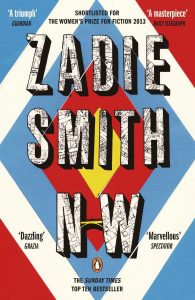
Like most of Smith’s work, NW engages with the issue of multiculturalism. Read up on this issue and critically discuss Smith’s particular take on it.
Before deepening the issue of multiculturalism, I want to specify some differences about the use of terminology like “multiculturalism” and “interculturalism”. In multiculturalism, differences between people and their cultures are celebrated as positive distinctive features, but seldom arriving to a real exchange between cultures. In intercultural communities, this exchange happens and there an alternation of immersion in different cultures. We cannot say what model is the best in our societies, but we can observe the reality and transpose it into literature for a better understanding. London seems the best example for better explaining these differences: different cultures share the same territory, bur hardly ever they share and exchange something more than the city they live in. The multicultural literature responds to the necessity of explaining the identity of a second generation in a society unaware of its selfishness.
Nw is set in the north-western part of London. The surroundings in this an important part of the notion of multiculturality they talk about:
If you have ever taken a ride back home on a London night bus, from the centre of town to one of the outer boroughs, you will know that it is an experience that can be, by turns, rowdy, lyrical, melancholy, heartwarming and hair raising; […] Reading Zadie Smith’s new novel, “NW”, is very much like getting onto one of those night buses (Shaw, 2013).
The “multicultural novel” in the United Kingdom seems closely related to his capital city, London. Several writers described London from their personal point of view, as immigrants or second generation children living in England and thus projecting their personal lives in the ones of their characters. Zadie Smith was born in Brent, a neighborhood in the North-West of London, to a Jamaican mother and an English father. Her personal life is similar to the lives of other famous “multicultural author” who wrote stories set in London. Monica Ali was born in Bangladesh to a Bangladeshi father and an English mother. In Brick Lane (2003) -name of the street in which mainly lives the Bangladeshi community in London- she tells the story of a Bangladeshi woman moving to London. Stephen Kelman was raised in the Marsh Farm, a social estate in Luton known for its social problems. In 2011 he published Pigeon English, the story of Ghanaian immigrant living in an unaccommodating estate in London. Hanif Kureishi is probably the most famous author of this literary genre. He was born in South London to a Pakistani father and an English mother and he became famous as a novelist with The Buddha of Suburbia (1990) and Something to Tell You (2008). Kureishi states that “questions of race, identity and culture were the major issues post-colonial Europe had to face” (2005). The colonialism is strictly related to the multiculturalism we can fell in London, even in literature. It seems that in contemporary literature we can find a compromise with new possible notions of identity and, in particular, British identities. This leads us to something unexpected, like multicultural literature, taking to another level social differences we used to confront with in colonial literature.
Smith’s novel is not really built with a linear story, presenting suggestions about the lives of four different characters, all united by the sorrow created by the search for their own identity. Throughout her oeuvre, she is engaged with the topics of nationhood, cultural alienation, multiculturalism and post-colonialism. In NW, the protagonists are the example of a post-colonial mixing. The novel opens with a focus on Leah, maybe the most “local” character, but she is keeping out of sight two of the hostile cultures in the British isles: the Irish and the English. From this little clashing identity, people all around her reveal global origins: “her husband [Michel] is half Algerian, half Guadeloupean; her best friend [Natalie] is first-generation Caribbean; and her friend’s husband [Nathan] is the product of a park encounter between a rich Italian woman and a man from Trinidad” (Enright, 2012). Leah seems so attracted by “otherness” that “she lacks room for a substantive self” (Childress Custer, p. 14).
In NW, language is used as a method to disorientate and thus trying to reach a sort of truth, or a conclusion: is multiculturalism leading us to be “liquid strangers”, instead of enriching our personal cultures and identities?
Bibliography
Zadie Smith, NW: a novel, Penguin Books, 2012
Susan Shaw, London: Lost and Found in Zadie Smith’s new novel, published on
18/10/2013 by Jol Press. Consulted on 12/12/2014 at http://www.jolpress.com/zadie-smith-nw-literature-london-multiculturalism-novel-article-822435.html#yHvLWpJFVg4KjwvO.99
Hanif Kureishi, “The carnival of culture”. The Guardian, 04/08/2005. Consulted on
12/12/2014 at http://www.theguardian.com/world/2005/aug/04/religion.uk
Heather Childress Custer, Zadie Smith’s NW: A Compass in Sad Multicultural
Land, University of North Carolina.
Anne Enright, “Mind the Gap. NW by Zadie Smith”. The New York Times,
21/12/2012. Consulted on 12/12/2014 at http://www.nytimes.com/2012/09/23/books/review/nw-by-zadie-smith.html?pagewanted=all&_r=0

Como casi todo los libros que leo, compré este libro por casualidad. Tenía ganas de leer algo de Rosa Montero, periodista y escritora madrileña, y me crucé con La rídicula idea de no volver a verte, publicado en 2013.
Lo compré sin fijarme en la sinopsis. Ma cautivaron el título y la foto, y me llevé una sorpresa al empezar a leerlo: no era una novela, sino una biografía-periodistica-autobiografía, acompañada de fotos y otros recuerdos de Marie Słodowska-Curie, científica y madre de la radioactividad, primera persona en recibir dos premios Nobel y primera mujer profesora en la Universidad de París. Rosa Montero, a partir de la lectura del diario de Marie, elabora una biografía en estilo periodistico -eso sí, utilizando mucho el “#” típico de las redes sociales y que poco tiene que ver con un libro- de la científica polaca.
Gracias a este libro podemos conocer más la vida privada de la premio Nobel, a partir de su infancia hasta su legado como investigadora y mujer. Marie tuvo que luchar desde pequeña para poder seguir estudiando, sacrificaba hasta la comida para poder tener dinero para su laboratorio.
Rosa Montero también reflexiona sobre su vida y lo parecido que pueden ser vidas tan distantes y diferentes, como la de una periodista y de una científica.
Si buscáis un libro interesante, ligero y que al mismo tiempo haga reflexionar sobre la condición de la mujer, este libro es para vosotros.
Cada mañana Manuel se despertaba a las 6.40. Tardaba quince minutos en levantarse de la cama, poco más en asearse, salir de casa e ir a coger el autobús. Se subía al vehículo a las 7.34, y desde ese momento no pensaba nada más que en el autobús de vuelta a las 18.38, a la cena que todos los días se preparaba –una sopa de pollo en sobre y un poquito de jamón-, a la hora de televisión que veía –únicamente cadenas de programas sin sentido, de estos que no tienen noticias- para luego acostarse a las 22.
Desde aquel día ya no cogía el coche, ni como copiloto. Intentaba evitar cualquier medio de transporte, y lo consiguió durante un año, 365 días que le concedieron de baja después del accidente. Como si un año curase problemas de salud mental.
Estrés post-traumático, decían. Se transformó en depresión algunos meses después. A él no interesaba darle un nombre, sólo sabía que el cuerpo le pesaba tanto que a veces ni podía levantarse de la cama.
Después del accidente su teléfono no paraba de sonar. Los familiares primero, después los amigos. Y también empezaron a llamar ministros, políticos, hasta el rey se molestó en preguntarle cómo estaba. Manuele siempre contestaba lo mismo: ¿Cómo quieres que esté? Y luego dejaba a las personas decir lo que querían, fingiendo escuchar sus palabras que siempre empezaban con un “Lo siento mucho”, y seguían con “Me enteré por la tele”.
Manuel no, no se enteró por la tele. Estaba allí en coche, conduciendo su todoterreno recién estrenado. Acababa de comprarlo después de una promoción en el trabajo. Iban a celebrarlo él, su mujer Miriam y su hija Aurora con un viaje a Cerdeña.
Nunca llegaron a su primer destino, Génova. Iban por la autopista cercana a la ciudad, soñando con visitar el célebre Acuario y contentos porque finalmente podían pasar un tiempo como familia.
Manuel casi no se dio cuenta. Iba pisando el acelerador, cuando empezó a sentir como que se caía hacia abajo, el coche y el puente que estaban cruzando junto con él. Miriam y Aurora empezaron a gritar, nunca olvidará sus caras asustadas mientras intentaba coger a las dos de las manos. Todo duró pocos segundos, hasta que cayeron en el río que el puente cruzaba.
Desde ese momento Manuel recuerda esos pocos segundos, el vacío debajo de los pies, las caras de su mujer y su hija que nunca volvió a ver.
Se despertó en el hospital. Los médicos decían que era un milagro que estuviese vivo sin ninguna secuela del accidente. Preguntó enseguida por sus dos mujeres. Nadie lo miró a la cara mientras le decían que no sobrevivieron.
Cada mañana Manuel se despertaba a las 6.40. Cada mañana, en esos quince minutos que tardaba en levantarse, buscaba las manos de su mujer y su hija en la cama.
