Over the years I have tried many methods as a teacher, but no one has ever satisfied me because I could not verify and follow the progress of my students.
The turning point came when as a teacher I became – again! – a student: my French teacher used this method to correct our tasks for level B1. As a student, I noticed the improvements little by little and this stimulated me to continue writing and striving.
But what is this method about?
Simply, it is a different form of correcting: instead of presenting the correction, we underline the error by classifying it. In this way, the pupil is not lost thinking about the type of error he/she made and how to correct it, but he/she is already routed to the possible solution. The student is then asked to correct the text following the teacher’s instructions. The student does not always arrive immediately at the solution, but it will certainly be easier to identify and correct the mistake.
To make it easier to understand and correct the text, the best way is to present a list of acronyms used for the correction at the beginning of the course in order to guide the revision of the text.
List of acronyms for writing correction
Above you can download for free the PDF of the form I have prepared for my students.
The following article is a short essay and review realised as part of a take-home exam for Postromantic Materialism course held at the University of Leuven in 2014-2015.
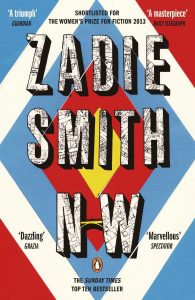
NW by Zadie Smith is available on Amazon.com. Click to buy!
Like most of Smith’s work, NW engages with the issue of multiculturalism. Read up on this
issue and critically discuss Smith’s particular take on it.
Before deepening the issue of
multiculturalism, I want to specify some differences about the use of
terminology like “multiculturalism” and “interculturalism”. In
multiculturalism, differences between people and their cultures are celebrated
as positive distinctive features, but seldom arriving to a real exchange
between cultures. In intercultural communities, this exchange happens and there
an alternation of immersion in different cultures. We cannot say what model is
the best in our societies, but we can observe the reality and transpose it into
literature for a better understanding. London seems the best example for better
explaining these differences: different cultures share the same territory, bur
hardly ever they share and exchange something more than the city they live in.
The multicultural literature responds to the necessity of explaining the
identity of a second generation in a society unaware of its selfishness.
Nw is set in the north-western part of London. The surroundings in this an important part of the notion of multiculturality they talk about:
If you have ever taken a ride back home on a London night bus, from the centre of town to one of the outer boroughs, you will know that it is an experience that can be, by turns, rowdy, lyrical, melancholy, heartwarming and hair raising; […] Reading Zadie Smith’s new novel, “NW”, is very much like getting onto one of those night buses (Shaw, 2013).
The “multicultural novel” in the
United Kingdom seems closely related to his capital city, London. Several
writers described London from their personal point of view, as immigrants or
second generation children living in England and thus projecting their personal
lives in the ones of their characters. Zadie Smith was born in Brent, a neighborhood
in the North-West of London, to a Jamaican mother and an English father. Her
personal life is similar to the lives of other famous “multicultural author”
who wrote stories set in London. Monica Ali was born in Bangladesh to a
Bangladeshi father and an English mother. In Brick Lane (2003) -name of the street in which mainly lives the
Bangladeshi community in London- she tells the story of a Bangladeshi woman
moving to London. Stephen Kelman was raised in the Marsh Farm, a social estate
in Luton known for its social problems. In 2011 he published Pigeon English, the story of Ghanaian
immigrant living in an unaccommodating estate in London. Hanif Kureishi is
probably the most famous author of this literary genre. He was born in South
London to a Pakistani father and an English mother and he became famous as a
novelist with The Buddha of Suburbia
(1990) and Something to Tell You
(2008). Kureishi states that “questions of race, identity and culture were the
major issues post-colonial Europe had to face” (2005). The colonialism is
strictly related to the multiculturalism we can fell in London, even in
literature. It seems that in contemporary literature we can find a compromise
with new possible notions of identity and, in particular, British identities.
This leads us to something unexpected, like multicultural literature, taking to
another level social differences we used to confront with in colonial
literature.
Smith’s novel is not really built with a linear story, presenting suggestions about the lives of four different characters, all united by the sorrow created by the search for their own identity. Throughout her oeuvre, she is engaged with the topics of nationhood, cultural alienation, multiculturalism and post-colonialism. In NW, the protagonists are the example of a post-colonial mixing. The novel opens with a focus on Leah, maybe the most “local” character, but she is keeping out of sight two of the hostile cultures in the British isles: the Irish and the English. From this little clashing identity, people all around her reveal global origins: “her husband [Michel] is half Algerian, half Guadeloupean; her best friend [Natalie] is first-generation Caribbean; and her friend’s husband [Nathan] is the product of a park encounter between a rich Italian woman and a man from Trinidad” (Enright, 2012). Leah seems so attracted by “otherness” that “she lacks room for a substantive self” (Childress Custer, p. 14).
In NW, language is used as a method to disorientate and thus trying to reach a sort of truth, or a conclusion: is multiculturalism leading us to be “liquid strangers”, instead of enriching our personal cultures and identities?
Bibliography
Zadie
Smith, NW: a novel, Penguin Books, 2012
Susan
Shaw, London: Lost and Found in Zadie Smith’s new
novel, published on