In questo post raccolgo i libri che ho letto nel 2023, in ordine temporale. Non c’è una logica nella scelta dei libri. Spesso e volentieri sono libri che volevo leggere da tempo, o che ho riletto, o che mi hanno attirato l’attenzione per un qualsiasi particolare. In totale sono 25, in italiano, inglese e spagnolo. Qual è il mio preferito e quale consiglierei? Scoprilo!
Jerry Spinelli, Stargirl
Un regalo di una grande amica, è la dimostrazione che i libri per giovanotti sono adatti anche ai più grandi. Jerry conosce Stargirl, una ragazza unica che non vuole essere una fra tanti. Anche se sembra accettare le conseguenze di essere sempre fuori dal coro, Stargirl in realtà soffre. Jerry si troverà a pensare riflettere su come essere unici in un mondo che ci vuole tutti uguali.
Il Post/Iperborea, Cose spiegate bene. E giustizia per tutti
Ossessionata dal true crime, ero incuriosita da questa rivista pubblicata da Il Post. Non mi ha delusa: il sistema giudizia è davvero spiegato bene, raccontando cosa succede quando avviene un crimine e spiegandolo sia dal punto di vista degli indagati che delle vittime.
Ernest Hemingway, The Old Manand the Sea
In libreria da molto tempo e con una curiosità rinnovata dalla vicinanza al mondo della vela e della pesca, l’ho preso in mano. Per me è stata un po’ una delusione: non sono riuscita a trovare la profondità nelle descrizioni delle uscite di pesca. Gli darò una seconda possibilità?
Juan Gómez Jurado, Reina Roja
Primo di una trilogia, Reina roja ha come protagonista Antonia Scott, una detective sui generis. Questo giallo/thriller/noir merita la trasposizione in serie appena uscita su Prime Video.
Javier Marías, Berta Isla
Uno dei miei romanzi preferiti dell’anno. Javier Marías è uno degli scrittori più importanti della scena contemporanea spagnol e questo libro è sicuramente uno dei suoi migliori e mi è stato consigliato da un grande amico. Berta Isla sposa Tomás, amico della gioventù, e pensa di sapere tutto di lui. Ma le sue assenze e i misteri che avvolgono la figura del marito logoreranno la relazione, ma fino a che punto? Ho in sospeso la lettura di Tomás Nevinson, la stessa storia raccontata dal punto di vista opposto.
Critically discuss the text’s deployment of notions of
allegiance and inheritance, domesticity and community. Identify key passages
and comment.
As Corocoran states,
The Heat of the Day, a story about entangled loyalties and treacheries -in war, in love and in relationships across the generations- is itself a generated out of a radical sense of destabilizations and disorientations. (Corcoran, 2004:168)
It is to underline that the notions of allegiance, inheritance, domesticity and community are deeply modified by the context in which they develop: the war and a London destroyed by bombing.
Characters yearn for a time when the family and its home could fulfill their need for purpose and identity, but they also suspect that this is never to be. Torn between romantic nostalgia for wholeness, security, and stability and denial of their often-disappointing history, they understand but ignore the way a perfectly knowable past foretells their difficult future. (Lassner, 1991:75).
These notions are also intertwined in different ways throughout the
novel: in chapter 15, for example, allegiance goes together with community. In
chapter 5, community lies in the same field as domesticity and allegiance.
Inheritance goes with community, and so on. As well as these notions intertwine
between one another, the book also deepens the effects of the “big history”
-World War I, the battle of Dunkirk in 1940, the bombing in London and so on-
on the domestic lives: Victor, Stella’s husband, leaves her for his nurse who
took care of him after he was wounded during WWI; also Robert was wounded and
became lame after the battle of Dunkirk.
During chapter 5, the protagonist, Stella, ponders on the changing behaviour of the inhabitants of London and the idea of community: “The wall between the living and the living became less solid as the wall between the living and the dead thinned” (Bowen, 1983:126); “each hoped not to die that night, still more not to die unknown” (1983:126) “[…] the indifference of the embattled city to private lives, the exiguousness and vagueness of everybody’s existence among the ruins could, but for Roderick, have made that easy” (1983:128).
The war changes the priorities in a society, making everyone aware that the person sitting next to you could be your salvation or your sentence to death. “The boundaries between self and other, ally and enemy have collapsed” (Gildersleeve, 2014:124). Knowing “whom or what to believe” (Ritchie, 1974:61) is one of the central ideas of the novel: Stella goes against Robert to protect him, literally surrendering to Harrison. But she does not know who Robert really is, until chapter 15 when the discuss all past experiences together from a new point of view. At this point strongly steps in the idea of allegiance, not only from the point of view of Robert, now uncovered, but also from Stella’s view. Robert points out his idea of democracy and freedom: “Freedom. Freedom to be what?—the muddled, mediocre, damned. […] Tell a man he’s free and what does that do to him but send him trying to dive back into the womb?” (Bowen, 1983:379-380)
The clearest references of the novel are the ones to allegiance: as it could be interpreted as a spy story, the loyalty to homeland is a basic assumption. Of course, the first idea we can make of this notion of spying comes from the relationship between Stella and Robert. The notion of allegiance also lies in the relationship between Stella and her son Roderick, a 19-year-old boy who becomes a soldier. Stella always fears to lose him but mainly his essence lost through the the presence in the army.
For what nagged at her, what flickered into her look each time she confronted the soldier in battle dress, was the fear that the Army was out to obliterate Roderick. In the course of a process, a being processed, she could do nothing to stop, her son might possibly disappear. (Bowen, 1983:49)
In chapter 15 Robert explains
Stella the reason why she is mad at him: “What is repulsing you is the idea of
‘betrayal,’ I suppose, isn’t it?” (1983:379). Allegiance is a concept also
present in the complicated relationship between England and Ireland. After his
death, Cousin Francis cannot cross the sea to be buried in Ireland. We also
read of bitter opinions about Ireland: “Ireland? Things may not be what they
were in that unfortunate country, but you won’t get me to believe that chap
[Cousin Francis] is an Irishman! So what was he up to there, I should like to
know?” (1983:110).
In this book we are far from the idea of domesticity we see, for example, in To the Lighthouse. Stella and Louie, female protagonists, are never
described while doing some domestic work, as it always happened with Mrs.
Ramsay. In the first part of the story Stella lives in Louie’s house, but for
her this does not mean feeling safe or protected: she finds shelter in people: “What
the inheritance came to be for Roderick, Robert was for Stella—a habitat” (1983:123).
The two women also have a strange consideration of respect in a couple:
the seem to look for partners for the sake of monogamy. Louie meets other men
in order to remember better her husband, away for the war, while Stella
sacrifices her own reputation not to reveal the real cause of the end of her
marriage, maybe also for the delight of being considered a femme fatale.
The
notion of inheritance is soon related to Roderick: after Cousin Francis’ death,
he inherits a property in Ireland:
“As against this, Roderick now owned property he had never seen. Last May, he had inherited from a cousin of his father’s a house in the south of Ireland, Mount Morris, with which went about three hundred acres of land. Probate, likely to be retarded by the complication of Mount Morris’s being where it was, had not yet been” (1983:65).
As
he can leave for the war, Roderick also thinks about the possibility of dying.
“Death could not estimate what it left behind it. […] Roderick reflected that, as things were, there would be nobody but his mother to be his heir, either: he felt this with chagrin both for himself and her—between them, they should have come to something further than this. He began to mutiny—which took the form of striking match after” (1983:443).
This paragraph is particularly
striking: a 19-year-old boy reflects not only about death, but also about
material concepts related to one’s death, contemplating the possibility of his
unnatural departure before his mother’s.
Bibliography
Bowen, Elizabeth, The Heat of the Day, Penguin Books, 1983. Quotes from a PDF version of the novel.
Corcoran, Neil. Elizabeth Bowen. The Enforced Return, Clarendon Press, Oxford, 2004
Gildersleeve, Jessica. Elizabeth Bowen and the Writing of Trauma. The Ethics of Survival. Rodopi, Amsterdam-New York, 2014
Lassner, Phyllis, “Elegies of Loss and Dispossession.” Elizabeth Bowen: A Study of the Short Fiction. Twayne’s Studies in Short Fiction 27, pp. 75-96. Twayne Publishers, New York, 1991. 75-96.
The Inheritance of Loss is available on Amazon.com (affiliated)
The following article is a short essay and review realised as part of a take-home exam for Postromantic Materialism course held at the University of Leuven in 2014-2015. You can also read an essay about NW by Zadie Smith and The Art of Fielding by Chad Harbach.
Discuss the novel’s epigraph,
Jorge Luis Borges’s “Boast of Quietness”.
In Boast of quietness (Jactancia
de quietud in Spanish) Borges speaks about the inevitability of time and
ponders on the identity of people who migrated. Borges was from Argentina and
lived in Europe for several years. Between 1923 and 1929 he wrote a lot about
his Argentinian roots and about Buenos Aires too.
Boast of Quietness is
a poem of the collection Luna de enfrente
(1925). This poem is focused on the opposition between “the ambitious”, people
who have not moved from the city and plan their entire life there, and the
poet, who speaks not only for himself but for all migrants too. The poet has
clarity about only two things of his future: his life and his death. The
ambitious never rest and do not have a bright viewpoint on humanity and
homeland. In Borges’s opinion, these two abstract concepts corresponds to clear
representations (“My humanity is in
feeling we are all voices of the same poverty”, line 8; “My homeland is the
rythym of a guitar, a few portraits, an old sword”, line 10). Borges “proclaims the inevitability of temporal
existence (“Time is living me”, line 12)” (Jenckes, 2007:24) and “the poet’s
passage through time is not in the name of anything, not even himself (“My name is someone and anyone”, line 15)” (2007:24).
The epigraph of Boast of Quietness is used as a poetic
example of people who go back and forth between cultures, but they manage not
to lose their own identity.
The author of The Inheritance of Loss portrayed
different characters for her novel: Jemubhai, a student of higher education in
London, Biju, an illegal immigrant in the United States, and Sai, an anglicized
girl living in India with her grandfather. The estrangement coming from a
migration experience is a recurrent topic in the post-colonial and migration
literature. Desai managed to build a novel in which not only the immigrant is
perceived as different, but also the inhabitants who become different after
being exposed to another culture, unfairly detected as superior.
In an interview of 2010[1],
the author Kiran Desai is asked why she chose the Borges’s poem Boast of Quietness. She answered:
This poem reflects the souls of the characters in the novel well. When you go to another country as a migrant, there are difficulties that you experience. The real important thing isn’t just your own story. There are many people’s stories like yours, and there are people who share the same fate, just as there are many books in a genre on library shelves. But you tell your own story. I selected this poem because it conveys similar feelings to readers. In the same way, when you look at the migration stories of Latin Americans and Mexicans, you can feel the parallels between all migrants’ stories. For this reason, Borges is a writer in whom I have a lot of trust in when it comes to conveying those feelings. (see note 1)
In the same interview, she states:
Being a migrant forces you to be creative because in one way or another you have a motivation […]. Your world and the environment you are in are changing, and this always makes you a more creative person. […] There is a light feeling of loss created by the migration feeling.
The author remembers another time Borges’s words in Boast of Quietness: “I walk slowly, like one who comes from so far away he doesn’t expect to arrive” (line16).
Bibliography
Kiran Desai, The Inheritance of
Loss, Grove Press, 2006
Jorge Luís Borges, Boast of
Quietness. Also
consulted: “Jactancia de quietud”, Luna
de
enfrente, Editorial Proa, Buenos Aires, 1925.
Kiran Desai: you are what you read, Sunday’s Zaman, published online September 12,
Kate Jenckes, Reading Borges after
Benjamin: Allegory, Afterlife and the Writing of
History, Suny Press, 2007
Nazneen Khan, Ravi Jauhari, Aspects
of immigration and diasporic sensibility in Kiran
Desais’s
The Inheritance of
Loss, Lapis Lazuli –An International Literary Journal, Vol.I, Issue.I, July
2011. URL: http://pintersociety.com/wp-content/uploads/2012/01/paper25.pdf
[1]Kiran Desai: you are what you read,
Sunday’s Zaman, published online September 12, 2010. Consulted on December 7,
2014. URL: http://www.todayszaman.com/arts-culture_kiran-desai-you-are-what-you-read_221398.html
The following article is an essay realised as part of a take-home exam for Postromantic Materialism course held at the University of Leuven in 2014-2015. You can find another take home exam about NW by Zadie Smith here.
The Art of Fielding is available on Amazon.com (Click to buy it)
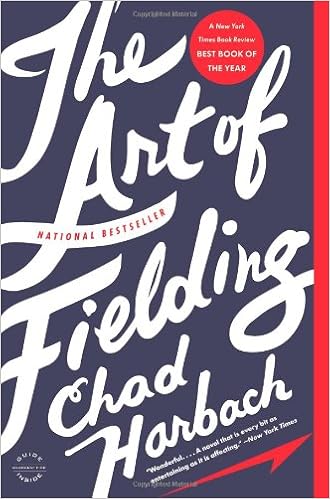
Facing fallibility in a world of winners: The Art of Fielding by Chad Harbach
People thought becoming an adult meant that all your acts had consequences; in fact it was just the opposite. Chad Harbach, The art of fielding
Introduction
The Art of Fielding (2011) is a novel written by Chad Harbach, an
American writer who made his debut as a novelist with a book about the life of
a 17-year-old baseball player, Henry Skrimshander, and his career as a
shortstop in the team of the Westish College, the Harpooners.
The book received a huge approval
from the critics and the general public, selling in a few months 250,000
printed copies and soon being introduced in the rankings of the best baseball
books of all times. In those charts, it stands next to other important novels
which also inspired famous movies: Shoeless
Joe (1982) by W. P . Kinsella -and the movie Field of Dreams (1989) with Kevin Costner; A League of Their Own (1992) by Sarah Gilbert -and the movie of the
same name with Geena Davis, Tom Hanks and Madonna, just to allude to most
famous worldwide.
In the USA, baseball is the “national past-time”. It is not difficult to understand why such novels dedicated to the ball game usually receive a lot of approval by the general public. But The Art of Fielding, even if based on the sport career of the protagonist, is more than that: through the adventures of a baseball team, Harbach manages to really underline and deeply analyze the problems of a teenager who feels below the average of his peers, the importance of team building and self consciousness not only for winning a game or the league, but also personal internal struggle against depression.
An intricate, poised, tingling debut. Harbach’s muscular prose breathes new life into the American past-time, recasts the personal worlds that orbit around it, and leaves you longing, lingering, and a baseball convert long after the last page.[1]
If we look at the narration or the
structure of the novel, we do not find anything special or more than the usual
structure of a fiction book. The narrator is omniscient, in third person: he
knows everything about all characters, but focus especially on the thinking of
the protagonists. The author leaves in the shadows only one character, Owen
Dunne: the reader can only imagine his thoughts and reactions because the
narrator never describes his interiority.
The
Art of Fielding is composed of 82 short chapters, each one finishing with a
cliffhanger and concerning the
stories of other characters not presented in the previous chapter.
Se avete voglia di viaggiare rimanendo sulla vostra poltrona e siete amanti delle lingue , questo è il libro che fa per voi!
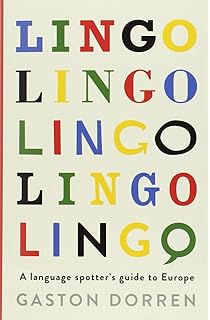
Consigliata da William Cisilino, direttore dell’Arlef, l’agenzia regionale per le lingue friulane, ho letto con piacere Lingo di Gaston Dorren, linguista olandese.
Ho sempre avuto una passione per la tipologia linguistica, la branca della linguistica che studia gli elementi in comune tra lingue anche apparentemente lontane tra di loro.
La copertina della versione inglese… (Clicca sull’immagine per comprarlo)
Dorren ci parla con semplicità di più di cinquanta lingue europee, presentando per quasi ogni lingua un prestito all’inglese e un suggerimento lessicale.
Un altra qualità del libro, come già ho accennato in precedenza, è l’estrema facilità di lettura. Anche un non-linguista può capire perfettamente le storie delle lingue, la loro configurazione sintattica e morfologica. Dorren spiega con estrema naturalezza concetti anche molto complessi, come l’ergatività del basco o la fonetica inglese.
Decisamente consigliato a chi ama le lingue (e parla l’inglese fluentemente, perchè non esiste una versione italiana di questo saggio).